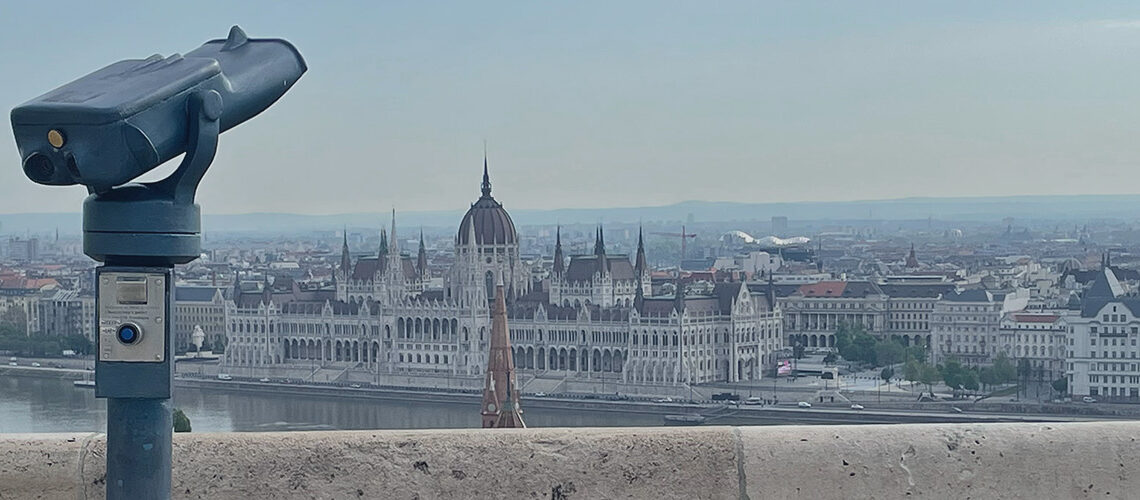
Budapest is blue—not just because of the Danube, but also because of its skies, thermal waters and beautiful Art Nouveau details. After more than a decade of guiding visitors through the city, I've realised that this colour quietly connects many of Budapest's most memorable places. When visitors describe Budapest, they often talk about its grand architecture, historic cafés or magnificent views over the Danube. But after spending more than a decade guiding travellers through the city, I've noticed something much quieter. Budapest has a colour. And that colour is blue. Once you begin looking for it, you'll find it almost everywhere. Not because someone planned it that way, but because nature, history and architecture have quietly combined to give the city its own distinctive palette. The Danube: Budapest's Blue Heart The first place you'll notice it is, of course, the Danube. Flowing between Buda and Pest, the river has shaped the city's history for centuries. Whether you're standing on the Chain Bridge, enjoying the view from the Buda Castle District or watching the Parliament reflected in the water, the river provides a constant ribbon of blue running through Budapest. It's one of the reasons so many of my private Budapest tours include several viewpoints overlooking the Danube—the perspective changes throughout the day, but the river always remains the city's defining feature. Looking Up Most visitors spend their time looking straight ahead. Try looking up instead. Many of Budapest's beautiful Art Nouveau buildings are decorated with colourful ceramic tiles produced by the famous Zsolnay factory. Soft turquoise, cobalt and deep blue details appear on rooftops, façades and decorative ornaments, rewarding those who slow down and pay attention. If you enjoy discovering these architectural details, you might also like my article about Budapest's hidden Art Nouveau treasures. The Colour of Water Blue
Budapest is blue—not just because of the Danube, but also because of its skies, thermal waters and beautiful Art Nouveau details. After more than a decade of guiding visitors through the city, I’ve realised that this colour quietly connects many of Budapest’s most memorable places.
When visitors describe Budapest, they often talk about its grand architecture, historic cafés or magnificent views over the Danube. But after spending more than a decade guiding travellers through the city, I’ve noticed something much quieter.
Budapest has a colour.
And that colour is blue.
Once you begin looking for it, you’ll find it almost everywhere. Not because someone planned it that way, but because nature, history and architecture have quietly combined to give the city its own distinctive palette.
The Danube: Budapest’s Blue Heart
The first place you’ll notice it is, of course, the Danube.
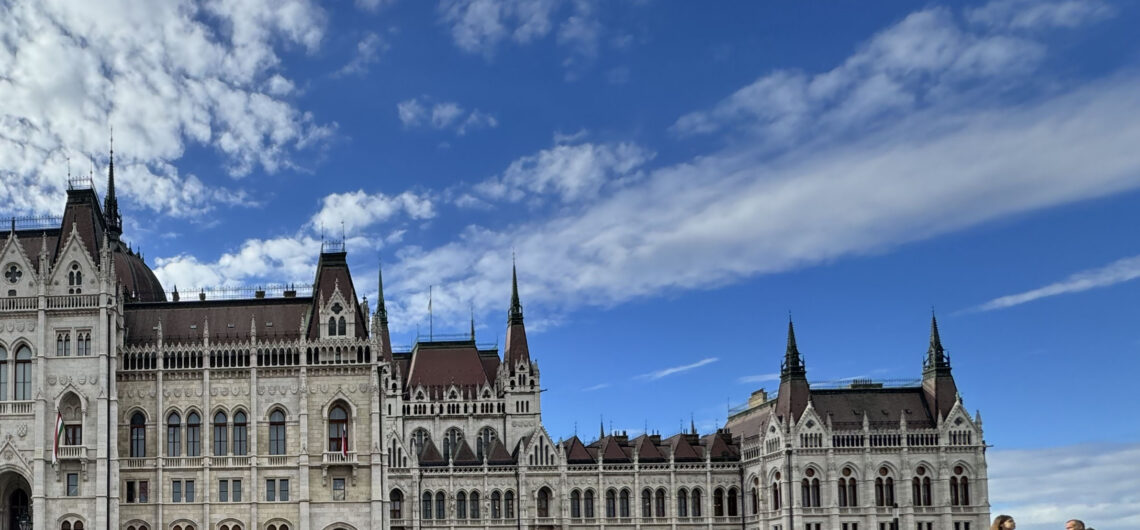
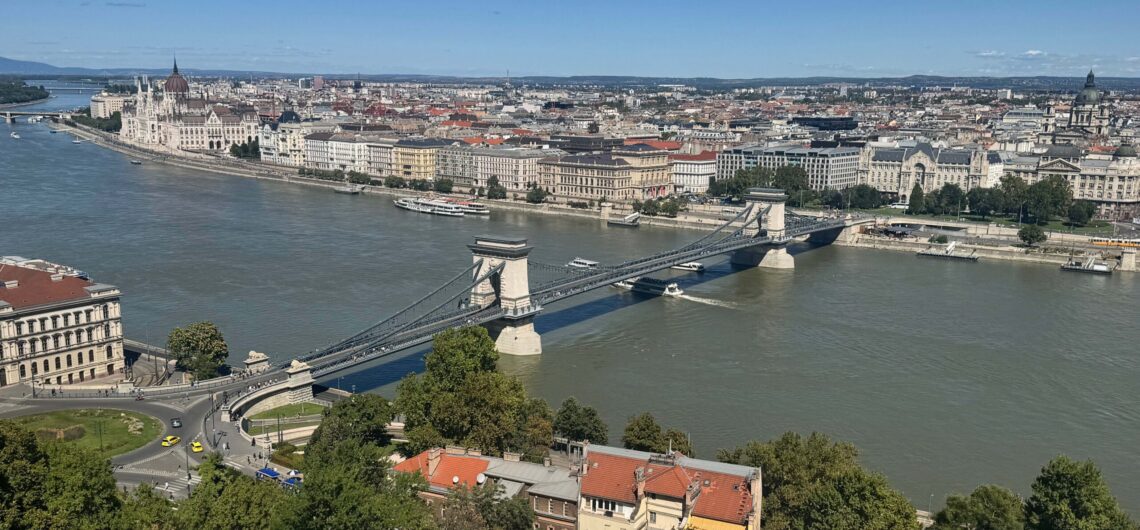
Flowing between Buda and Pest, the river has shaped the city’s history for centuries. Whether you’re standing on the Chain Bridge, enjoying the view from the Buda Castle District or watching the Parliament reflected in the water, the river provides a constant ribbon of blue running through Budapest.
It’s one of the reasons so many of my private Budapest tours include several viewpoints overlooking the Danube—the perspective changes throughout the day, but the river always remains the city’s defining feature.
Looking Up
Most visitors spend their time looking straight ahead.
Try looking up instead.
Many of Budapest’s beautiful Art Nouveau buildings are decorated with colourful ceramic tiles produced by the famous Zsolnay factory. Soft turquoise, cobalt and deep blue details appear on rooftops, façades and decorative ornaments, rewarding those who slow down and pay attention.
Whether it’s the outdoor pools beneath the summer sky or the elegant indoor baths reflecting through historic windows, water has always been part of Budapest’s identity. It isn’t just a place to relax—it tells the story of a city built on more than one hundred thermal springs.
Every bath has its own atmosphere, but they all share the same connection between history and water.
Hidden Details
Sometimes the most memorable discoveries are also the smallest.
Blue mosaic tiles, ceramic decorations, painted doorways and unexpected architectural details appear throughout the city. They’re easy to miss if you’re rushing from one famous attraction to another, but they add another layer to Budapest’s character.
They’re also a reminder that the best way to explore the city is slowly.
Experience Budapest Beyond the Landmarks
One of my favourite parts of being a private tour guide is helping visitors notice the details they might otherwise walk straight past.
Whether it’s a hidden courtyard, an Art Nouveau façade or simply the changing colours of the Danube, these small discoveries often become the memories people talk about long after returning home.
If you’d like to experience Budapest at a relaxed pace and discover both its famous landmarks and its hidden stories, I’d be delighted to welcome you on one of my private Budapest tours.
Sometimes, all it takes is looking at the city a little differently.
And perhaps you’ll start seeing Budapest in blue too.
If you only have one day in Budapest, it’s tempting to try to see everything. But Budapest is not a city you should rush. Instead of ticking off landmarks, the best way to experience the city is to slow down, enjoy the atmosphere, and focus on a few key areas. Here’s a realistic way to spend one perfect day in Budapest. Start Your Day in Buda Begin your day on the Buda side of the city, where things often feel calmer in the morning. Walk through the Buda Castle District, enjoy the historic streets and take in the first views over the Danube. If this is your first visit, Fisherman's Bastion and Matthias Church are obvious highlights, but leave yourself a little time simply to wander. Some of my favourite corners of the Castle District are found away from the busiest viewpoints. Morning is one of my favourite times to explore this part of Budapest, before the day gets busier. Cross the Danube to Pest After exploring Buda, make your way across the river to Pest. Walking across the Chain Bridge is a wonderful way to experience the transition between the two sides of the city, but public transport can save valuable time if you prefer. On the Pest side, walk towards the Hungarian Parliament Building along the Danube. Depending on your interests, you could continue through Liberty Square towards St Stephen's Basilica, or simply take time to explore the smaller streets of the city centre. Take a Coffee Break Budapest has a wonderful café culture, and taking a break is part of the experience. Instead of rushing from one attraction to the next, stop for a coffee and a pastry. It’s the perfect way to slow down and enjoy the atmosphere of the city. Explore at Your Own Pace
If you only have one day in Budapest, it’s tempting to try to see everything. But Budapest is not a city you should rush.
Instead of ticking off landmarks, the best way to experience the city is to slow down, enjoy the atmosphere, and focus on a few key areas. Here’s a realistic way to spend one perfect day in Budapest.
Start Your Day in Buda
Begin your day on the Buda side of the city, where things often feel calmer in the morning.
Walk through the Buda Castle District, enjoy the historic streets and take in the first views over the Danube. If this is your first visit, Fisherman’s Bastion and Matthias Church are obvious highlights, but leave yourself a little time simply to wander. Some of my favourite corners of the Castle District are found away from the busiest viewpoints.
Morning is one of my favourite times to explore this part of Budapest, before the day gets busier.
Cross the Danube to Pest
After exploring Buda, make your way across the river to Pest. Walking across the Chain Bridge is a wonderful way to experience the transition between the two sides of the city, but public transport can save valuable time if you prefer.
On the Pest side, walk towards the Hungarian Parliament Building along the Danube. Depending on your interests, you could continue through Liberty Square towards St Stephen’s Basilica, or simply take time to explore the smaller streets of the city centre.
Take a Coffee Break
Budapest has a wonderful café culture, and taking a break is part of the experience.
Instead of rushing from one attraction to the next, stop for a coffee and a pastry. It’s the perfect way to slow down and enjoy the atmosphere of the city.
Explore at Your Own Pace
In the afternoon, continue exploring at a comfortable pace.
You might wander through the Jewish Quarter, discover small streets, or simply enjoy walking along the Danube promenade. This is where Budapest really comes to life — in the unexpected details. This is also the part of the day when I wouldn’t plan too much. If a courtyard catches your eye, go inside. If you find a beautiful building, stop and look up. If a café or little shop looks interesting, give yourself permission to change the plan.
End the Day with a Sunset
Finish your day somewhere with a view.
Depending on the season, you might watch the light change over the Danube from the riverbank, find a rooftop terrace for a relaxed drink, or return to the Buda side for a panoramic view as the city lights begin to appear.
Budapest is particularly beautiful at this hour, when the landmarks you’ve explored during the day begin to look completely different.
Want to Explore Budapest in One Day With a Private Guide?
If you have just one full day in the city, my Grand Budapest Walk is designed to give you a rich introduction to both Buda and Pest without turning the day into a race between landmarks.
Like all my Budapest private tours, the itinerary is fully customisable. We can focus more on history, architecture, food, Jewish heritage, hidden places — or simply build the day around the things that interest you most.
The goal isn’t to see everything in Budapest in one day. It’s to make the day you have here count.
One Day in Budapest Is Only the Beginning
You won’t see everything Budapest has to offer in one day — and that’s perfectly fine.
A wonderful day here isn’t about collecting as many landmarks as possible. It’s about understanding a little of the city’s history, noticing its beauty, enjoying its atmosphere and leaving with the feeling that there is still more you’d like to discover.
And perhaps that’s the best reason to come back.
One Day in Budapest - A Realistic Way to Experience the City
There are places in Budapest that impress you… and then there are places that make you pause. The Budapest State Opera House experience is firmly in the second category. I’ve walked through its grand foyer countless times with my guests, pointing out details, telling stories, watching their reactions as they look up—because everyone does. You simply can’t help it. The gold, the frescoes, the chandeliers… it’s overwhelming in the best possible way. But every now and then, I like to return not as a guide—but as a guest. And that’s when the magic truly begins. A Building Designed to Impress The Hungarian State Opera House opened in 1884, during one of Budapest’s most ambitious and elegant periods. Designed by the famous Hungarian architect Miklós Ybl, it was built to rival the great opera houses of Vienna and Paris—and many would say, it succeeded. From the outside, it’s already impressive. But the real experience begins the moment you step inside. Marble columns, sweeping staircases, and ceilings painted with mythological scenes set the tone immediately. And then, of course, there’s the auditorium—rich red velvet, gold balconies, and one of the most beautiful chandeliers in the city. It’s the kind of place where even before the performance starts, you already feel like you’re part of something special. More Than Just a Performance One of my favourite moments is just before the curtain rises. There’s a quiet energy in the room. People settle into their seats, the orchestra tunes, conversations soften. It’s a shared anticipation—and even if you don’t come to the opera regularly, you feel it instantly. And then, for a few hours, the outside world disappears. A Different Perspective: From a Private Box This time, I had the chance to watch from a private box—and I have to say, it changes everything.
There are places in Budapest that impress you… and then there are places that make you pause. The Budapest State Opera House experience is firmly in the second category.
I’ve walked through its grand foyer countless times with my guests, pointing out details, telling stories, watching their reactions as they look up—because everyone does. You simply can’t help it. The gold, the frescoes, the chandeliers… it’s overwhelming in the best possible way.
But every now and then, I like to return not as a guide—but as a guest. And that’s when the magic truly begins.
A Building Designed to Impress
The Hungarian State Opera House opened in 1884, during one of Budapest’s most ambitious and elegant periods. Designed by the famous Hungarian architect Miklós Ybl, it was built to rival the great opera houses of Vienna and Paris—and many would say, it succeeded.
From the outside, it’s already impressive. But the real experience begins the moment you step inside. Marble columns, sweeping staircases, and ceilings painted with mythological scenes set the tone immediately. And then, of course, there’s the auditorium—rich red velvet, gold balconies, and one of the most beautiful chandeliers in the city.
It’s the kind of place where even before the performance starts, you already feel like you’re part of something special.
More Than Just a Performance
One of my favourite moments is just before the curtain rises.
There’s a quiet energy in the room. People settle into their seats, the orchestra tunes, conversations soften. It’s a shared anticipation—and even if you don’t come to the opera regularly, you feel it instantly.
And then, for a few hours, the outside world disappears.
A Different Perspective: From a Private Box
This time, I had the chance to watch from a private box—and I have to say, it changes everything.
Opening the door and seeing the auditorium from that angle feels almost like stepping into another era. It’s more intimate, more theatrical. You’re not just watching the performance—you’re part of the scene itself.
Moments like this are a reminder of how these spaces were originally designed: not just for music, but for experience, for atmosphere, for a certain kind of elegance that still lingers today.
A Stop on My Tours
Even if you don’t attend a performance, the Opera House is still absolutely worth visiting.
I often include the main foyer in my private walking or driving tours of Budapest. It’s one of those places that adds a layer of cultural depth to the city—something beyond the usual sights.
It’s also a perfect way to understand Budapest’s golden age, when the city was growing rapidly and wanted to show the world just how sophisticated it had become.
Budapest: A City of Music
The Opera House is just one part of Budapest’s rich musical life.
Another favourite of mine is the Liszt Academy of Music—an equally stunning building, but with a very different atmosphere. While the Opera House feels grand and theatrical, the Academy is more intimate and deeply connected to Hungary’s musical heritage.
If you enjoy live music, I always recommend checking what’s on during your stay. Whether it’s opera, classical concerts, or even smaller performances, Budapest offers something special year-round.
Is It Worth It?
Absolutely. Even if you’re not a regular opera-goer, this is about more than the performance. It’s about stepping into a space where architecture, history, and culture come together in a way that feels both grand and personal at the same time. If you’re looking for a truly memorable cultural highlight, a Budapest Opera House experience is something I always recommend.
And honestly, it’s one of those evenings you’ll remember long after your trip.
A Little Tip
If you’re visiting Budapest and considering an evening at the Opera House, I’m always happy to help you choose the right performance—or include the building as part of a private tour.
Because sometimes, the best way to experience a place… is to understand the story behind it.
You’d Never Expect This… Budapest Opera House Experience
There is something magical about spring in Budapest. After months of grey skies and chilly mornings, the city begins to wake up. The terraces slowly fill with conversation, the parks turn green again, and warm breezes drift through the streets carrying the promise of brighter days ahead. And then, almost suddenly, the cherry blossoms arrive. For a few short but unforgettable days each year, delicate pink blossoms bloom across Budapest, transforming quiet corners of the city into scenes that feel almost dreamlike. One of the most beautiful places to experience this is in the Buda Castle District, where soft petals frame historic streets and centuries-old buildings in shades of springtime pink. But this year, spring feels a little different. Perhaps it is the sunshine, perhaps it is the blossoms, or perhaps it is the feeling that something new is in the air—not just in nature, but in the city itself. Budapest seems to be stepping into spring with a little more energy, a little more joy, and a quiet sense of optimism for the season ahead. Cherry blossoms have long symbolized renewal, hope, and the beauty of fleeting moments. And somehow, this year, they feel especially fitting. There is laughter in the air, music drifting from open windows, and the unmistakable sense that Budapest is welcoming not only a new season, but perhaps a new chapter as well. Why Spring Is One of the Best Times to Visit Budapest If you are planning to visit Budapest, spring may be the perfect season. The weather is mild, the city is colourful, and locals seem to spend every possible moment outdoors enjoying the sunshine after the long winter months. Café terraces overflow onto the sidewalks, flowers bloom in the parks, and the golden evening light makes the city even more photogenic than
There is something magical about spring in Budapest.
After months of grey skies and chilly mornings, the city begins to wake up. The terraces slowly fill with conversation, the parks turn green again, and warm breezes drift through the streets carrying the promise of brighter days ahead.
And then, almost suddenly, the cherry blossoms arrive.
For a few short but unforgettable days each year, delicate pink blossoms bloom across Budapest, transforming quiet corners of the city into scenes that feel almost dreamlike. One of the most beautiful places to experience this is in the Buda Castle District, where soft petals frame historic streets and centuries-old buildings in shades of springtime pink.
But this year, spring feels a little different.
Perhaps it is the sunshine, perhaps it is the blossoms, or perhaps it is the feeling that something new is in the air—not just in nature, but in the city itself. Budapest seems to be stepping into spring with a little more energy, a little more joy, and a quiet sense of optimism for the season ahead.
Cherry blossoms have long symbolized renewal, hope, and the beauty of fleeting moments. And somehow, this year, they feel especially fitting.
There is laughter in the air, music drifting from open windows, and the unmistakable sense that Budapest is welcoming not only a new season, but perhaps a new chapter as well.
Why Spring Is One of the Best Times to Visit Budapest
If you are planning to visit Budapest, spring may be the perfect season.
The weather is mild, the city is colourful, and locals seem to spend every possible moment outdoors enjoying the sunshine after the long winter months. Café terraces overflow onto the sidewalks, flowers bloom in the parks, and the golden evening light makes the city even more photogenic than usual.
One of my favourite places to admire cherry blossoms in Budapest is the Buda Castle District. The contrast of soft pink petals against the grand historic buildings creates one of the most romantic spring scenes in the city.
If you enjoy hidden viewpoints and peaceful walks, you might also love visiting Gül Baba’s tomb, one of Budapest’s secret gardens with stunning Parliament views.
Experience Budapest in Bloom
Spring is one of my favorite seasons for private tours because Budapest simply feels happier. The streets are lively, the weather is comfortable, and the whole city seems to glow with fresh energy.
If you would like to discover Budapest’s hidden corners, local stories, and beautiful spring atmosphere with a local guide, explore my private Budapest tours.
If you only have a few hours in Budapest, planning is everything. The city is full of stunning architecture, rich history, and beautiful viewpoints — but without a clear route, it’s easy to waste time going back and forth. This guide will help you focus on the essential Budapest highlights, so you can experience the best of the city even on a tight schedule. 1. Heroes’ Square & City Park Start your visit at one of the most important squares in Hungary: Heroes’ Square. The statues here represent Hungary’s most important historical figures, making it a perfect introduction to the country’s past. Just behind the square, you’ll find City Park, a green oasis with hidden gems like Vajdahunyad Castle — ideal for a short, relaxed stroll before heading into the city center. 2. Andrássy Avenue & the Opera House From Heroes’ Square, follow Andrássy Avenue, one of Budapest’s most elegant boulevards and a UNESCO World Heritage site. Lined with historic buildings, cafés, and embassies, it leads you straight toward the city center. On the way, you’ll pass the stunning Hungarian State Opera House, a masterpiece of 19th-century architecture. Read more: Budapest public transport tips (Metro Line 1 runs here) 3. St. Stephen’s Basilica Next, head to St. Stephen’s Basilica, the largest Catholic church in Budapest. The interior is impressive — but if you have time, go up to the dome. The panoramic view offers one of the best perspectives over the city. Local tip: Visit in the late afternoon for softer light and fewer crowds. 4. The Hungarian Parliament No visit to Budapest is complete without seeing the Hungarian Parliament Building. Standing right on the Danube, it’s one of the most iconic buildings in Europe. For the best view, take a short walk along the river — or admire it
If you only have a few hours in Budapest, planning is everything.
The city is full of stunning architecture, rich history, and beautiful viewpoints — but without a clear route, it’s easy to waste time going back and forth.
This guide will help you focus on the essential Budapest highlights, so you can experience the best of the city even on a tight schedule.
1. Heroes’ Square & City Park
Start your visit at one of the most important squares in Hungary: Heroes’ Square. The statues here represent Hungary’s most important historical figures, making it a perfect introduction to the country’s past.
Just behind the square, you’ll find City Park, a green oasis with hidden gems like Vajdahunyad Castle — ideal for a short, relaxed stroll before heading into the city center.
2. Andrássy Avenue & the Opera House
From Heroes’ Square, follow Andrássy Avenue, one of Budapest’s most elegant boulevards and a UNESCO World Heritage site. Lined with historic buildings, cafés, and embassies, it leads you straight toward the city center.
On the way, you’ll pass the stunning Hungarian State Opera House, a masterpiece of 19th-century architecture.
Standing right on the Danube, it’s one of the most iconic buildings in Europe. For the best view, take a short walk along the river — or admire it from the Buda side for a full panoramic perspective.
5. Buda Castle District
Cross the Danube and explore the historic Buda Castle District.
This area feels completely different from Pest — quieter, more atmospheric, and full of history. Wander through cobblestone streets, discover hidden corners, and enjoy some of the best views in Budapest.
It depends on how many hours you have and how deeply you want to explore.
In around four hours, I would usually prioritise rather than trying to rush through every stop on this list. Distances, traffic, the hills on the Buda side and interior visits can quickly use up valuable time.
If you have closer to six hours, it becomes much easier to combine both sides of the city at a comfortable pace.
Want to Make the Most of a Few Hours in Budapest?
If your time in Budapest is limited, a private half-day Budapest tour can be customised around your schedule, interests and pace. We can concentrate on the essential highlights while still leaving time for the stories and smaller details that make the city memorable.
If you enjoy exploring on foot, my private Budapest walking tours can be adapted to the time you have available. Or, if you’d like to cover more ground — or simply prefer a more comfortable pace — a private Budapest tour by car is an excellent alternative.
Whether you prefer walking or travelling with a private driver, my aim is the same: to help you experience as much of Budapest as possible without making the city feel like a checklist.
Final Thoughts
Budapest is a city that rewards curiosity. Even if you only have a few hours, you can experience so much of its beauty — especially if you focus on the right places and leave yourself enough time to actually enjoy them.
Sometimes a few well-chosen hours are all you need to begin falling in love with Budapest.
Every year on the 15th of March, Hungary commemorates one of the most important moments in its history: the beginning of the Revolution of 1848. It is a day when Hungarian flags appear across Budapest, red-white-green cockades are pinned to jackets, and the city remembers the courage of those who demanded freedom. But this national holiday is not only about remembering a historical event. It is about remembering a moment when words, ideas, and determination changed the course of a nation’s history. The Day the Revolution Began The events of the 15th of March, 1848 began in Pest with a group of young intellectuals known as the March Youth. Among them was the poet Sándor Petőfi, whose passionate poem Nemzeti Dal (National Song) became the voice of the revolution. Standing before a growing crowd, Petőfi recited the poem beginning with the powerful words: "Talpra magyar, hí a haza!""Rise up, Hungarians, the homeland calls!" The poem captured the spirit of the moment. Inspired by revolutionary movements spreading across Europe in 1848, the crowd demanded political reform and national independence. Their demands were summarized in a document known as the Twelve Points, which called for: freedom of the press equality before the law a Hungarian government independent from Vienna civil rights and national sovereignty the end of feudal privileges Remarkably, the revolution in Pest began without violence. Printing presses produced copies of the Twelve Points without censorship, crowds gathered peacefully, and political prisoners were freed. For a brief moment, it seemed that a new chapter of Hungarian history had begun. The Hungarian Flag and the Cockade One of the most recognizable symbols of the revolution was the red-white-green tricolour, the Hungarian national flag. These colours had appeared earlier in Hungarian history, but during the revolution they became a powerful symbol of unity
Every year on the 15th of March, Hungary commemorates one of the most important moments in its history: the beginning of the Revolution of 1848.
It is a day when Hungarian flags appear across Budapest, red-white-green cockades are pinned to jackets, and the city remembers the courage of those who demanded freedom.
But this national holiday is not only about remembering a historical event. It is about remembering a moment when words, ideas, and determination changed the course of a nation’s history.
The Day the Revolution Began
The events of the 15th of March, 1848 began in Pest with a group of young intellectuals known as the March Youth. Among them was the poet Sándor Petőfi, whose passionate poem Nemzeti Dal (National Song) became the voice of the revolution.
Standing before a growing crowd, Petőfi recited the poem beginning with the powerful words:
“Talpra magyar, hí a haza!” “Rise up, Hungarians, the homeland calls!”
The poem captured the spirit of the moment. Inspired by revolutionary movements spreading across Europe in 1848, the crowd demanded political reform and national independence. Their demands were summarized in a document known as the Twelve Points, which called for:
freedom of the press
equality before the law
a Hungarian government independent from Vienna
civil rights and national sovereignty
the end of feudal privileges
Remarkably, the revolution in Pest began without violence. Printing presses produced copies of the Twelve Points without censorship, crowds gathered peacefully, and political prisoners were freed.
For a brief moment, it seemed that a new chapter of Hungarian history had begun.
The Hungarian Flag and the Cockade
One of the most recognizable symbols of the revolution was the red-white-green tricolour, the Hungarian national flag.
These colours had appeared earlier in Hungarian history, but during the revolution they became a powerful symbol of unity and national identity.
Even today, on March 15, many Hungarians wear a cockade made from these colours — a small circular ribbon pinned to clothing. This tradition connects modern Hungary with the revolutionaries of 1848 who wore the same symbol of patriotism.
Walking through Budapest on this day, you see flags hanging from historic buildings, bridges, and balconies across the city.
The red, white, and green colours remind people not only of the past, but also of the enduring importance of freedom. The three colours of the Hungarian flag tell a story of their own: red symbolises the blood and passion of those who fought for freedom, white represents honesty and integrity, and green reflects hope for the nation’s future.
The Revolution and Its Legacy
Although the revolution eventually led to a war with the Habsburg Empire and was ultimately suppressed in 1849, its ideals continued to shape Hungarian identity.
Many of the political and social reforms demanded in 1848 eventually became reality. More importantly, the revolution became a lasting symbol of the Hungarian desire for independence and self-determination.
Hungarian history includes several moments when people stood up for freedom.
One of the most powerful examples was the 1956 uprising against Soviet rule, another event that deeply shaped modern Budapest and the national memory.
Understanding these moments helps visitors see Budapest not only as a beautiful city, but also as a place where history was lived with extraordinary courage.
Experiencing the 15th of March in Budapest
If you happen to visit Budapest around the 15th of March, you will see a very special atmosphere in the city.
Public squares host commemorations, historic locations connected to the revolution are visited by locals, and Hungarian flags appear everywhere. The holiday is both festive and reflective — a quiet but powerful reminder of the ideals that shaped the country.
For visitors interested in the deeper layers of Hungarian history, these stories often come alive when walking through the city itself. Many of the historic streets connected to Budapest’s past — including areas like the Jewish Quarter — reveal how layers of history shaped the city we see today.
Many of the places connected to Hungary’s struggles for freedom can still be seen today — from the streets where the revolution began to the monuments remembering later events such as the 1956 uprising. Fortunately, many of these historic sites are easy to reach thanks to Budapest’s excellent public transportation system, which makes exploring the city simple for visitors.
Why This History Matters Today
One of the most moving aspects of the 15th of March is that the revolution was not only fought with weapons.
It was fought with poetry, ideas, and courage. The words spoken in the streets of Pest in 1848 continue to echo through Hungarian history, reminding people that freedom often begins with the courage to imagine a different future.
Every Hungarian flag displayed on this day carries that message forward. Whenever I walk through Budapest on the 15th of March, I can’t help wondering what the young revolutionaries of 1848 would expect from us today. Reading the Twelve Points, it is striking how timeless their message remains. The ideals of freedom, equality before the law, and responsible government still resonate deeply, reminding us that the spirit of 1848 continues to challenge and inspire every generation.
Budapest is a city where history is not only remembered — it is lived in its streets, squares, and stories. If you would like to explore these layers of history while discovering the city with a local guide, I would be delighted to show you around on one of my private tours.
March 15 Budapest 🇭🇺 Nemzeti Menet | Hungary’s National Day
Few buildings define Budapest as instantly as Matthias Church. Rising above the Buda Castle District with its colourful tiled roof and fairy-tale silhouette, it is one of the most photographed landmarks in the Hungarian capital. And yet, many visitors admire it from a distance without discovering what makes it truly remarkable. Taking a closer look reveals centuries of history, architectural details often missed at first glance, and one of the most rewarding cultural experiences in Budapest. A Church Shaped by Centuries of History Matthias Church stands on a site where places of worship have existed since the 13th century. Over time, the building has witnessed royal ceremonies, coronations, Ottoman occupation, and major reconstructions that shaped its present appearance. Despite its medieval origins, much of what visitors see today comes from a careful 19th-century restoration led by architect Frigyes Schulek, who created the distinctive Neo-Gothic character while preserving earlier historical elements. This layered history is part of its charm — Matthias Church reflects the many chapters of Budapest itself rather than belonging to a single era. Look Closer: Details Many Visitors Miss From afar, the church almost feels unreal, but its beauty truly appears in the details. The colourful roof, covered with decorative Zsolnay tiles, changes character depending on the light and weather throughout the day. Walking around the building reveals carved stone figures, patterned surfaces, and unexpected viewpoints that many visitors miss when remaining near the main square. Even a slow walk around the church can feel like discovering a different monument from every angle. Step Inside Matthias Church While the exterior alone is impressive, stepping inside offers a completely different experience. From the outside, Matthias Church appears bright, colourful, and almost newly restored. The interior, however, reveals an unexpected contrast — darker, more atmospheric, and deeply historic. Medieval architectural
Few buildings define Budapest as instantly as Matthias Church. Rising above the Buda Castle District with its colourful tiled roof and fairy-tale silhouette, it is one of the most photographed landmarks in the Hungarian capital.
And yet, many visitors admire it from a distance without discovering what makes it truly remarkable.
Taking a closer look reveals centuries of history, architectural details often missed at first glance, and one of the most rewarding cultural experiences in Budapest.
A Church Shaped by Centuries of History
Matthias Church stands on a site where places of worship have existed since the 13th century. Over time, the building has witnessed royal ceremonies, coronations, Ottoman occupation, and major reconstructions that shaped its present appearance.
Despite its medieval origins, much of what visitors see today comes from a careful 19th-century restoration led by architect Frigyes Schulek, who created the distinctive Neo-Gothic character while preserving earlier historical elements.
This layered history is part of its charm — Matthias Church reflects the many chapters of Budapest itself rather than belonging to a single era.
Look Closer: Details Many Visitors Miss
From afar, the church almost feels unreal, but its beauty truly appears in the details.
The colourful roof, covered with decorative Zsolnay tiles, changes character depending on the light and weather throughout the day. Walking around the building reveals carved stone figures, patterned surfaces, and unexpected viewpoints that many visitors miss when remaining near the main square.
Even a slow walk around the church can feel like discovering a different monument from every angle.
Step Inside Matthias Church
While the exterior alone is impressive, stepping inside offers a completely different experience.
From the outside, Matthias Church appears bright, colourful, and almost newly restored. The interior, however, reveals an unexpected contrast — darker, more atmospheric, and deeply historic. Medieval architectural elements blend with decorative patterns influenced by the Ottoman period, reminding visitors of the many eras the building has lived through.
Standing inside, Hungarian history feels almost tangible. The richly decorated walls, painted motifs inspired by medieval designs, and filtered light from stained glass windows create a calm and contemplative atmosphere — a striking change from the lively square just outside.
Even visitors with limited time often find that a short visit inside adds depth to their understanding of Budapest’s past and cultural heritage.
Climb the Tower for One of Budapest’s Best Views
While most visitors admire Matthias Church from the square below, one of its most memorable experiences lies above the rooftops.
The tower visit offers a completely different perspective of Budapest — and remains surprisingly overlooked. Reaching the top requires climbing a series of narrow stairs, but the ascent itself becomes part of the experience. On the way up, visitors can see the church bells up close, offering a rare glimpse into the inner workings of this historic landmark.
From the very top, panoramic views open over the Buda Castle District, the Danube, and the Pest side of the city, including the Hungarian Parliament. The climb also reveals one of the church’s most remarkable features from a completely new angle: the magnificent Zsolnay roof tiles, fully visible only from above, creating a true bird’s-eye view of the building’s intricate patterns and colours.
Unlike larger viewpoints, the experience feels intimate and immersive, allowing you to see Budapest from within one of its most historic monuments rather than simply looking at it from afar.
For visitors willing to take the climb, the tower provides one of the most unique viewpoints in Budapest — and often becomes an unexpected highlight of a visit to Matthias Church.
Visiting Tips for Matthias Church
If you’re planning to visit Matthias Church, a few practical tips can make the experience much more enjoyable:
Visit early in the morning or later in the afternoon to avoid peak crowds in the Buda Castle District.
Check opening hours carefully. The church interior may be closed on Saturday afternoons due to weddings, and it is closed on Sunday mornings during church services.
Walk around the entire building, not just the main entrance area — some of the most beautiful architectural details appear on the quieter sides.
Don’t miss the interior gallery. From here, you gain a stunning elevated view over the church’s richly decorated interior. The gallery also includes a small exhibition dedicated to Hungarian coronations, reflecting the church’s important role as a coronation church in the 19th and 20th centuries.
Climb the tower if you can. Although there are stairs to climb, the panoramic views make it truly worth the effort.
Combine your visit with Fisherman’s Bastion, located directly beside the church, for iconic views over the Danube and the Hungarian Parliament.
Comfortable shoes are recommended, as the surrounding streets are historic cobblestones.
Beyond the Postcard View
Budapest’s most famous landmarks often reveal their beauty slowly. Matthias Church is a perfect example — instantly recognisable, yet far richer when experienced with curiosity and time.
Looking beyond the postcard view transforms a quick photo stop into a meaningful moment in the Buda Castle District.
When I guide visitors through Budapest, I often encourage them to pause here a little longer. Taking time to notice the details, stepping inside the church, or climbing the tower often turns this famous landmark into a personal highlight of the visit.
Because sometimes, truly knowing a city begins with looking closer.
Matthias Church Budapest: Look Closer at This Icon
Today we celebrate the Budapest 152nd birthday. On November 17, 1873, three historic towns — Buda, Pest, and Óbuda — united to form one magnificent city: Budapest. I can’t help but reflect on why this place continues to capture my heart — and the hearts of travellers from all over the world. It’s incredible to think how much history, resilience, and beauty fit into these 152 years. Budapest isn’t just Hungary’s capital — it’s a city that tells stories at every turn, from its majestic bridges to its cozy cafés. A City of Timeless Beauty If you’re looking for things to do in Budapest, you don’t have to go far. Start with the Hungarian Parliament, one of Europe’s most stunning government buildings, glowing golden at night on the banks of the Danube. Cross over the Chain Bridge, admire the Fisherman’s Bastion at sunrise, and don’t miss a ride on Tram 2, often called one of the most scenic tram routes in the world. Whether you explore Buda Castle Hill for history or Andrássy Avenue for architecture, every view tells a story. So you will explore a mix of grandeur, resilience, and unmistakable charm. Need more ideas? Let me know! Everyday Magic - Happy Birthday Beautiful Budapest! What makes Budapest truly special is how easily beauty blends into everyday life.You can enjoy a lazy morning at one of the city’s historic cafés, stroll along the Danube promenade, or simply watch the lights shimmer across the water as evening falls.Even locals (like me!) still stop to take in the view — because it never gets old. 💙 My Beautiful Budapest As a private tour guide in Budapest, I’ve had the joy of seeing visitors fall in love with the city — whether it’s their first visit or a long-awaited return. Each tour
Today we celebrate the Budapest 152nd birthday. OnNovember 17, 1873, three historic towns — Buda, Pest, and Óbuda — united to form one magnificent city: Budapest. I can’t help but reflect on why this place continues to capture my heart — and the hearts of travellers from all over the world.
It’s incredible to think how much history, resilience, and beauty fit into these 152 years. Budapest isn’t just Hungary’s capital — it’s a city that tells stories at every turn, from its majestic bridges to its cozy cafés.
A City of Timeless Beauty
If you’re looking for things to do in Budapest, you don’t have to go far. Start with the Hungarian Parliament, one of Europe’s most stunning government buildings, glowing golden at night on the banks of the Danube. Cross over the Chain Bridge, admire the Fisherman’s Bastion at sunrise, and don’t miss a ride on Tram 2, often called one of the most scenic tram routes in the world.
Whether you explore Buda Castle Hill for history or Andrássy Avenue for architecture, every view tells a story. So you will explore a mix of grandeur, resilience, and unmistakable charm. Need more ideas? Let me know!
What makes Budapest truly special is how easily beauty blends into everyday life. You can enjoy a lazy morning at one of the city’s historic cafés, stroll along the Danube promenade, or simply watch the lights shimmer across the water as evening falls. Even locals (like me!) still stop to take in the view — because it never gets old.
💙 My Beautiful Budapest
As a private tour guide in Budapest, I’ve had the joy of seeing visitors fall in love with the city — whether it’s their first visit or a long-awaited return. Each tour I lead feels like a love letter to this place: to its stories, flavours, and hidden corners that you won’t find in guidebooks.
Budapest is endlessly inspiring. It’s a city that makes you slow down, look up, and appreciate the details. Like the curve of a bridge, the scent of coffee, the sound of trams rolling by.
Here’s to the Next 152 Years – Happy Birthday Beautiful Budapest!
Budapest has lived through revolutions, rebuildings, and countless transformations. Yet, she always rises more beautiful, more vibrant, more alive. So today, I raise my glass (of Tokaji, of course!) to 152 years of history, culture, and beauty.
Happy Birthday, Beautiful Budapest — and thank you for continuing to inspire all who walk your streets. 💫
Here are my best Szechenyi Baths tips from a local guide to help you skip the lines, relax like a local, and make the most of your visit. If you’ve seen photos of people relaxing in steaming blue pools surrounded by grand yellow buildings — that’s Széchenyi Baths, Budapest’s most iconic thermal spa. But while everyone visits for the beauty, locals know the real secret is in how you visit.
Here are my best insider tips to make your experience smooth, relaxing, and truly local.
If you’d like to learn more about Budapest’s famous bath culture and its healing traditions, join my Budapest Baths Walking Tour for an in-depth experience — we’ll explore the history, architecture, and everyday rituals that make these places so special.
1. Go Early or Late for the Best Atmosphere
The baths open early, and that’s when the magic happens. If you arrive before 9 AM, you’ll share the steaming pools with just a handful of locals, chatting quietly as the morning mist rises. Evening is another wonderful time — warm water, golden lights, and a slower pace.
✨ Pro tip: Early morning and sunset are perfect for photos — and you’ll avoid the crowds.
2. Buy a Fast Track Ticket Online – the best one of the Szechenyi baths tips
Lines at Széchenyi can get long, especially on weekends and holidays. The easiest way to skip the queue is to book a Fast Track ticket, available for morning or afternoon sessions.
✨ Pro tip: Choose the morning slot for the quietest, most photogenic experience.
3. Use the Right Entrance of Szechenyi baths
Széchenyi is huge, with multiple entrances, and choosing the right one can save you time and confusion. Many first-time visitors feel overwhelmed by the size of the complex and the ticket options, but with a few simple Szechenyi Baths tips, you can skip the stress and relax like a local.
On-the-spot tickets: Use the side entrance near the Széchenyi Fürdő metro station (M1 line). This is where you can buy tickets directly at the counter.
Online tickets (standard): Enter via the main gate on Állatkerti körút (the grand yellow façade facing the CIRCUS).
Fast Track tickets: Use the special entrance on Kós Károly sétány — it’s usually quieter and has its own check-in area.
💡 Pro tip: Save a photo of your entrance gate on your phone — it’s easy to mix them up!
4. Bring the Essentials
Pack like a local:
Flip-flops or waterproof sandals (required)
Your own towel (rentals can be slow and pricey)
A plastic bag or dry pouch for valuables
Lockers are available, but if you’re visiting as a couple, read on…
5. Men’s and Women’s Lockers Are Separate
That’s right — the locker areas are divided by gender. So if you’re visiting with a partner and want to change together, choose a Cabin Ticket instead. Cabins are small private changing rooms and can be used by couples or families.
💡 Pro tip: Cabins are also handy if you’re bringing cameras or valuables you don’t want to leave in a locker.
6. Respect the Local Culture
For many Budapesters, Széchenyi isn’t just a tourist attraction — it’s part of daily life. Locals come to heal, relax, and meditate, often under doctor’s recommendation. So keep voices low, avoid filming strangers, and embrace the calm rhythm of the baths.
🙏 Think of it as a shared temple of water — not a pool party.
7. Stay Warm Between Pools
If you visit in winter, don’t worry — the outdoor pools are around 38°C (100°F), even when the air is freezing! But bring a robe or quick-dry towel to wrap up between dips.
8. Visit All Year Round
Whether you’re visiting in winter or summer, these Szechenyi Baths tips will help you plan smarter, save time, and truly enjoy the healing atmosphere that makes Budapest’s spa culture world-famous. Széchenyi is open every day of the year, and each season has its charm:
Winter: Steam, snow, and serenity
Spring: Blossoms in City Park nearby
Summer: Lively, colourful, full of laughter
Autumn: Warm water and golden leaves
✨ My Local Summary
If you plan it right — early morning, a Fast Track ticket, the correct entrance, a cabin, towel, and a little respect for the locals — you’ll discover why Széchenyi Baths are more than just beautiful architecture. They’re a living piece of Budapest’s soul. Let me know if you have questions or if you’d like to include the visit of a local bathhouse in your Budapest tour with me.
High above the Danube, tucked away in the quiet streets of Rózsadomb, lies one of Budapest’s most peaceful treasures: Gül Baba’s Tomb. It’s a place most visitors never find — a secret garden filled with roses, history, and calm.
A Hidden Piece of History
The story of Gül Baba’s Tomb stretches back to the 16th century, when the Ottoman Empire ruled Buda. Gül Baba, a dervish and poet-warrior whose name means “Father of Roses,” was buried here after the Turkish conquest. For centuries the site served as a Muslim burial place, then later became a Jesuit monastery, and even, for a time, the home of a Hungarian architect.
Each chapter added new layers, just like the petals of the roses that still bloom here today.
From the Past to the Present
After years of neglect, the tomb and its gardens were fully restored in 2018, transforming the hilltop into a serene public space. Now visitors can stroll through terraced rose gardens, admire the simple octagonal mausoleum, and enjoy a stunning panoramic view over Pest.
Despite being so close to the city center, it feels miles away from the bustle — a place where you can still hear birds and footsteps instead of traffic.
Why You Should Visit
Roses everywhere: fitting for the resting place of the “Father of Roses.”
Cultural layers: Ottoman, Christian, and Hungarian heritage intertwined.
Beautiful views: especially at sunset, when the domes glow golden.
Peace and reflection: perfect for a quiet break during your Budapest explorations.
Whether you come for the history or just to breathe in the scent of roses, Gül Baba’s Tomb offers a side of Budapest that many miss — soft, spiritual, and timeless.
Visiting Info
Address: Mecset utca 14, II district, Budapest Opening hours: Tuesday to Sunday 9 a.m. – 6 p.m. (check seasonal updates) Admission: free How to get there: Take Tram 4 or 6 to Margit híd budai hídfő, then a short, steep walk uphill through leafy streets.
If you’re exploring the city with me, Gül Baba’s Tomb can be a beautiful stop on a custom-designed itinerary — a gentle moment of calm and history that pairs perfectly with a cultural walk through Buda.
Whether you come for the history or just to breathe in the scent of roses, Gül Baba’s Tomb offers a side of Budapest that many miss. Vibes are soft, spiritual, and timeless.
A Peaceful Farewell
Whenever I visit, I’m reminded that Budapest isn’t only about grand buildings and lively cafés. It’s also about quiet corners like this one. If you ever need a moment to slow down, follow the scent of roses up Rózsadomb. You’ll find a poet’s resting place — and perhaps a little bit of peace for yourself, too. 💛