Budapest has a secret signature. And once you begin exploring Ödön Lechner, you’ll start recognising his style everywhere: in the curve of a window, the shape of a roof, a colourful ceramic tile or an unusual pattern decorating a façade.

You can find it in the curve of a window, the shape of a roof, a colourful ceramic tile or an unusual pattern decorating a façade. These details belong to different buildings, sometimes in completely different parts of Budapest. Yet look closely and you begin to recognise something familiar.

The same imagination. The same delight in colour and ornament. The same determination to create something new. And behind many of these extraordinary details is one man: Ödön Lechner, the architect who helped give Budapest a distinctly Hungarian architectural language.

I’ve always loved his buildings. Recently, while filming four of them, I found myself noticing just how beautifully their shapes, patterns and colours seem to speak to one another. So rather than introduce the buildings one by one, I thought we might follow those connections.

An Architect with an Idea

At the end of the 19th century, Budapest was transforming at extraordinary speed. The city was filling with grand apartment buildings, public institutions, avenues and palaces. Much of this architecture drew inspiration from established European styles: Renaissance, Baroque, Gothic and Classical.

Ödön Lechner had another idea. He believed that Hungary could develop a modern architectural style with a character of its own. His inspiration came from several directions. Hungarian folk art and decorative traditions were important, but so were Eastern artistic influences, contemporary European architecture and the possibilities offered by new building materials.

He brought these influences together with an imagination that was entirely his own. Today, Lechner is one of the great names associated with Hungarian Art Nouveau, or Szecesszió. But perhaps the easiest way to understand his work is to look at the details.

A Shape You Begin to Recognise

One of my favourite discoveries while filming was a particular window shape. I found variations of it on different buildings. The outlines weren’t identical, but they had something in common: an unusual curve, a playful silhouette, a sense that the window was part of a larger decorative composition.

Once I’d noticed the connection, I couldn’t stop looking for others. This is one of the pleasures of Lechner’s architecture. Windows become patterns. Rooflines take on unexpected shapes. Curves appear again in ornaments, entrances and façades.

Look at the Thonet House, with its remarkable ironwork and delicate decorative details, and then at the Hungarian Geological Institute or the Postal Savings Bank. These buildings serve very different purposes, but they share something of Lechner’s architectural handwriting. It is the kind of connection that is easy to miss when you’re simply walking from one famous Budapest landmark to another. And once you notice it, you begin to see the buildings differently.

Budapest, Written in Colour by Ödön Lechner

Then there are the colours. Lechner’s buildings can be wonderfully colourful, particularly where glazed ceramics become part of the architecture.  He worked with the famous Zsolnay factory in Pécs, whose innovative ceramic products offered exciting possibilities for architects. Founded in the 19th century and developed into an internationally renowned ceramics manufacturer under Vilmos Zsolnay, the factory became an important part of Hungary’s architectural story. Today, its former industrial complex is home to the Zsolnay Cultural Quarter, a fascinating place to discover the craftsmanship behind some of the country’s most remarkable buildings.

Ceramics could be decorative, durable and expressive. They could cover roofs, emphasise architectural shapes and introduce colour into places where earlier generations might have expected plain stone or plaster.

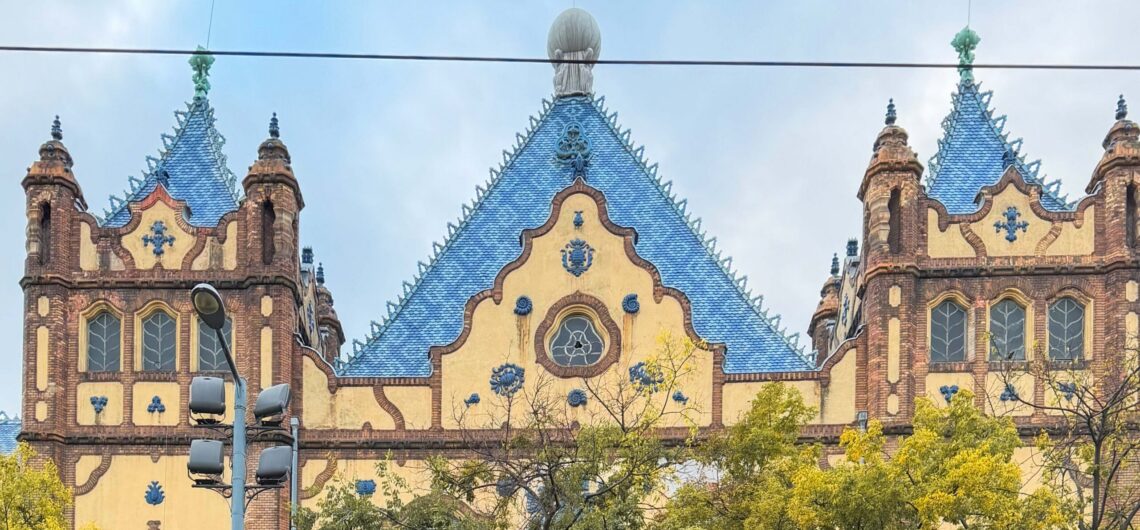
The Hungarian Geological Institute is one of my favourite examples. Its extraordinary blue roof makes the building immediately recognisable, but the real pleasure begins when you look more closely at the decorative details and the way the ceramics contribute to the whole composition.

At St Ladislaus Church in Kőbánya, the colourful roof creates a completely different impression. Here, patterns and colours contribute to the character of a church whose soaring tower and richly decorated surfaces seem almost to belong to a storybook. And yet there is something familiar about the way Lechner uses colour. The buildings are different. The imagination behind them is recognisable.

Patterns That Travel from Building to Building

One of the things I enjoy most about Budapest architecture is discovering how much thought went into details that many of us barely notice. A window surround. A piece of wrought iron. A ceramic ornament high above the street. In Lechner’s buildings, these details are rarely isolated decorations. They belong to a larger visual language.

Look at the ornamental surfaces of the Postal Savings Bank, with its lively patterns and symbolic decoration. Then look at the intricate details of the Thonet House or the colourful surfaces of the Geological Institute. You begin to recognise recurring interests: movement, rhythm, nature-inspired forms and the pleasure of turning an ordinary architectural element into something memorable.

Sometimes the connections are obvious. Sometimes they’re surprisingly subtle. That is what I find so fascinating. You can look at four buildings, each with its own purpose and personality, and still recognise the architect behind them.

Four Buildings, Four Very Different Personalities

The four buildings I filmed offer a wonderful introduction to Lechner’s Budapest.

  • The Thonet House, in the heart of Pest, is an earlier work and a fascinating example of his experimentation with materials and decoration.
  • The Postal Savings Bank is one of his most celebrated buildings, combining an inventive roofscape with wonderfully detailed ornament.
  • The Hungarian Geological Institute is perhaps the most immediately recognisable of the four, thanks to its distinctive blue roof and remarkable decorative programme.
  • And St Ladislaus Church, in Kőbánya, shows how Lechner could bring his imagination to religious architecture, creating something that feels both familiar and wonderfully unusual.

I love them for different reasons. But what struck me most while filming was how naturally the details connected. A curved shape on one building seemed to answer a similar shape on another. Blue ceramics led to colourful roof tiles. Decorative patterns appeared in different materials and on entirely different scales. It felt almost like discovering the same handwriting on four separate pages.

Why Lechner Still Matters

Lechner wanted Hungarian architecture to have a voice of its own. His work was part of a much larger conversation about national identity, modernity, craftsmanship and artistic freedom at the turn of the 20th century. Not every Hungarian Art Nouveau building was designed by Lechner, and the movement developed in many different directions.

But his influence was extraordinary. He helped demonstrate that architecture could draw inspiration from local traditions while embracing modern ideas and materials. More than a century later, his buildings still make Budapest feel different from other European capitals. And I think that’s worth celebrating.

Learning to Recognise His Signature

The lovely thing about Budapest by Ödön Lechner is that you don’t need to be an architecture expert to enjoy it. Start with a shape. Then look for another. Notice the colours, the ceramics, the rooflines and the patterns. Look above the shopfronts and beyond the ground-floor windows.

You may find yourself recognising connections between buildings that initially seem to have nothing in common. That’s one of my favourite things about exploring Budapest on foot: the city gradually teaches you how to look at it. And once you’ve begun noticing Lechner’s architectural handwriting, it’s difficult to stop.

Discover Budapest’s Art Nouveau Architecture

If Lechner’s buildings have caught your imagination, there is much more to discover. He was an extraordinary figure within a wonderfully creative period of Hungarian architecture. Budapest is full of Art Nouveau buildings, decorative details, stained glass, mosaics and remarkable stories that reward a closer look.

You can explore this wider architectural world in my article Looking Closer: Discovering Budapest Through Art Nouveau.

And if you’d like to discover these buildings and their stories together, my Budapest Art Nouveau Private Walking Tour is designed for exactly that kind of curiosity.

As with all my private tours, we can shape the experience around the architecture, places and details that interest you most. Because Budapest has many stories written into its buildings. Ödön Lechner left one of its most beautiful signatures.
Budapest Has a Secret Signature | Ödön Lechner

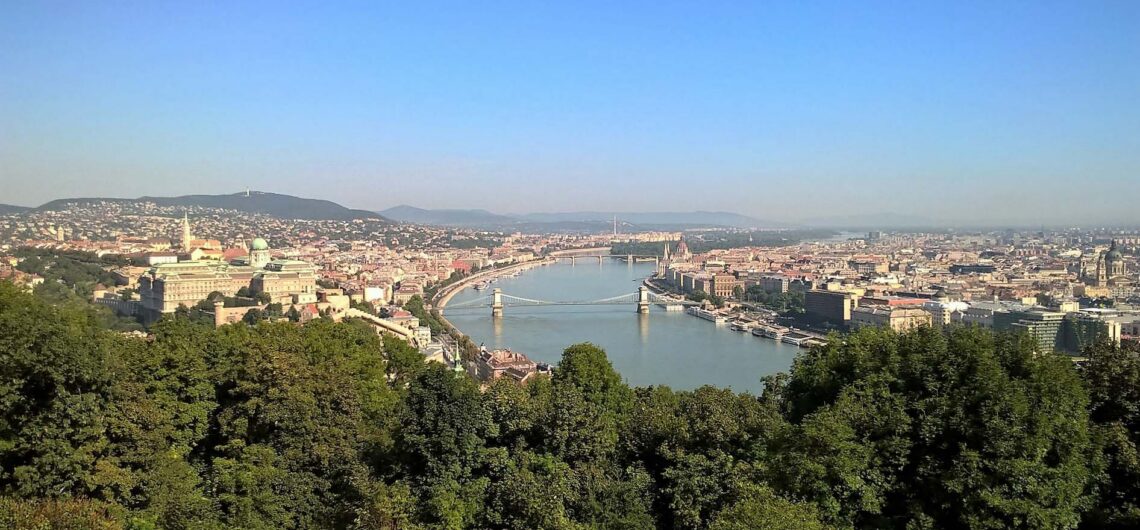
One of the questions I am often asked on my tours is why Buda and Pest feel so different. The difference between Buda and Pest becomes surprisingly obvious once you cross the Danube. Buda is the hilly western side of the Danube; Pest is the flatter eastern side.

On the Buda side, streets climb into the hills, the city feels greener and quieter, and the Castle District still follows a very different rhythm from downtown Budapest. Cross to Pest and everything seems to open out: long avenues, busy trams, cafés, shops and rows of grand 19th-century buildings.

Today we think of all of this simply as Budapest. But for most of their history, Buda and Pest were not two sides of the same city at all. They were separate places.

First Things First: Buda and Pest Really Were Separate Cities

Budapest officially came into existence in 1873, when Buda, Pest and Óbuda were united into a single city. By then, settlements had existed on both sides of the Danube for centuries, but they had developed differently. Buda grew around the hills on the western bank. Castle Hill became a royal and political centre in the Middle Ages, while other settlements spread along the river and into the surrounding hills. Across the Danube, Pest developed on much flatter land. It became increasingly important for trade and commerce and, particularly during the 19th century, expanded at extraordinary speed.

The river separated them, but geography had already given each side a very different character.

Geography Came First

This is perhaps the simplest explanation for why Buda and Pest still feel different today.

Buda is hilly. Pest is mostly flat.

That sounds almost too obvious to matter, but geography influenced how both sides developed. In Buda, roads have to climb, curve and adapt to the landscape. There are stairways, retaining walls, viewpoints and streets that suddenly disappear around a corner. Houses climb the hillsides and greenery slips between them. Pest could spread outwards across the plain. Its streets could become longer and straighter. Large boulevards and avenues could cut through the expanding city. Dense blocks of apartment buildings could grow around them.

Even today, you can often tell which side of Budapest you are on without seeing the Danube. Your feet will tell you.

Buda: Hills, History and a Different Pace

For many visitors, Buda means the Castle District. This is where you find some of Budapest’s best-known historic landmarks, including Matthias Church, the Royal Palace and the winding streets of the old town.

But Buda isn’t simply “the old side” of Budapest. That would be far too easy. The Castle District contains medieval streets and surviving fragments from earlier centuries, but much of what we see today has been rebuilt, restored and reimagined repeatedly. Matthias Church is a wonderful example. Its origins go back to the Middle Ages, but its appearance today owes an enormous amount to the 19th-century reconstruction led by Frigyes Schulek. Even its extraordinary colourful tiled roof tells a much more recent story than you might expect.

That mixture of periods is one of the reasons I enjoy walking here. Buda doesn’t present its history in a neat chronological order. Medieval, Ottoman, Habsburg, 19th-century and 20th-century Budapest all sit surprisingly close together.

And beyond the Castle District, Buda changes again. There are residential neighbourhoods, wooded hills, gardens and quieter streets. The city feels less dense. Sometimes you can almost forget that Pest, with all its noise and movement, is just across the river.

If this is the Budapest that interests you most, my Historical Buda Castle Walk explores these layers in much more detail.

Pest: The City Spreads Out

Then you cross the Danube. Pest feels different almost immediately. It is flatter, denser and more urban, and much of the cityscape visitors associate with Budapest today took shape during the extraordinary growth of the 19th century.

This is the Budapest of grand avenues and apartment houses, cafés, theatres, shops and trams. It is where you find the Hungarian Parliament, St Stephen’s Basilica, Andrássy Avenue and the Hungarian State Opera House.

Architects such as Miklós Ybl helped give this rapidly growing city its sense of confidence and grandeur. Later, Ödön Lechner and others began asking an even more interesting question: could Budapest develop an architectural language of its own? We will return to those gentlemen another day. They deserve considerably more than one paragraph.

But architecture is only part of Pest’s character. This was also the commercial, cultural and increasingly cosmopolitan heart of the growing city. That energy hasn’t disappeared. Walk through Pest today and you still encounter markets, cafés, shops, offices, theatres and restaurants woven into the everyday life of the centre.

My Best of Pest tour concentrates on this side of Budapest and is a lovely way to understand how Pest became the city we see today.

And What About Óbuda?

There is a small complication in the Buda-versus-Pest story. There were actually three cities involved. When Budapest was created in 1873, Buda and Pest were united with Óbuda, whose name literally means “Old Buda”. Óbuda lies to the north of central Buda and has an even longer history. The Roman town of Aquincum developed in this area, and traces of Roman Budapest are still visible today.

So although we usually talk about Buda and Pest, Budapest is really the result of three cities becoming one. The name simply didn’t have room for all three. And I think we can probably be grateful for that. Pestbudaó might have been difficult to market.

1873: One City, Two Very Different Characters

The unification of Buda, Pest and Óbuda came at an extraordinary moment. Budapest was growing rapidly. Bridges increasingly connected the two banks, transport improved, enormous building projects transformed the city and the approaching millennium celebrations of 1896 accelerated its development even further. The two sides became parts of one capital. But they didn’t become identical. And fortunately, they still aren’t.

There is modern architecture in Buda and ancient history beneath Pest. There are busy roads in Buda and wonderfully quiet streets in Pest. The distinction is never as simple as:

Buda = old. Pest = new.

But the different landscapes and the different ways the two sides developed have left a character you can still feel.

You Can Feel the Difference by Walking

This is one of the reasons I love exploring Budapest on foot. Crossing the Danube isn’t simply a way of getting from one attraction to another. It changes the rhythm of the walk.

Come down from Castle Hill and Buda gradually releases you towards the river. Cross one of the bridges and Pest draws you into a much denser city of façades, trams, cafés and streets. Go in the opposite direction and the effect reverses. The flat streets of Pest suddenly give way to a landscape that starts climbing.

You don’t need to know exactly where one historical settlement ended and another began. Your feet tell you. And once you begin noticing the difference, Budapest becomes much easier to understand.

Buda or Pest: Which Is Better?

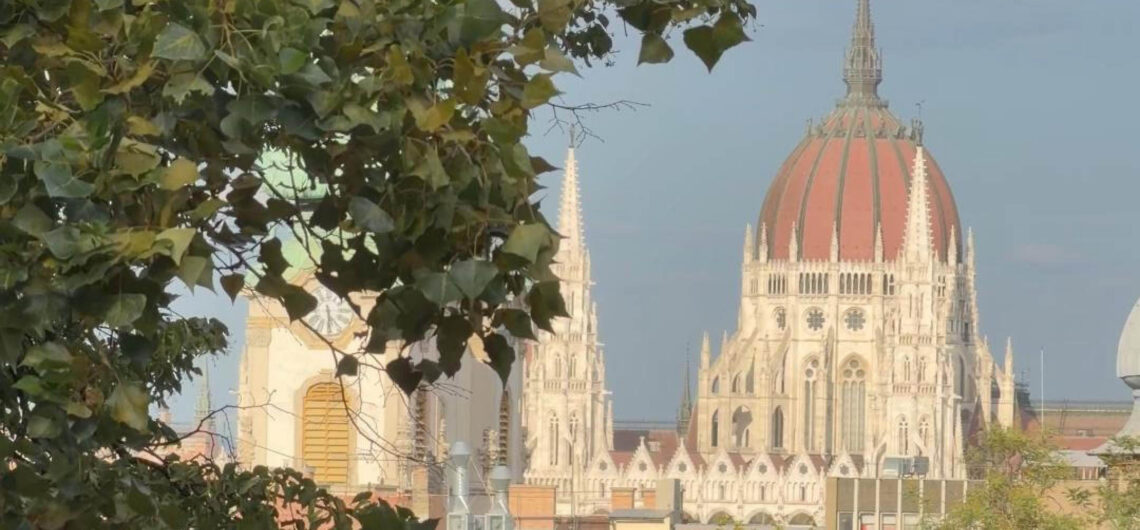
This may be the easiest question of all. Neither. Or both. I love the contrast between them. Buda gives Budapest its hills, views and some of its deepest historical layers. Pest gives it much of its metropolitan energy and architectural grandeur. And the Danube gives us the space to see one from the other. From Buda, you look across towards Parliament and the Pest skyline. From Pest, Castle Hill rises above the opposite bank.

Each side makes the other more interesting. That is why, on a longer walk through Budapest, I particularly enjoy taking guests across the river. The moment you cross a bridge, you haven’t simply reached the next sight.

The city changes around you.

Two Sides. One Budapest.

Buda and Pest have shared a name for more than 150 years. Fortunately, they never became quite the same. If Buda’s winding streets and layers of history appeal to you most, my Historical Buda Castle Walk explores that side of the city in depth. If you’re more curious about the grand boulevards, architecture and everyday life of Pest, the Best of Pest stays on the other side of the river.

And if choosing between them seems impossible, don’t. My Grand Budapest Walk brings the two sides together — which, after all, is rather the point of Budapest. Cross the river when you’re here.

Budapest makes much more sense once you’ve walked both sides.

Buda vs Pest: Two Sides of Budapest

The Matthias Church roof is one of those Budapest sights I thought I knew very well. I have walked past it hundreds of times, shown it to countless guests and photographed it from almost every direction.

Then, the other day, I started looking at the tiles. Not the roof. The individual tiles. And suddenly one of the most familiar buildings in Budapest became interesting all over again.

Budapest, One Tile at a Time

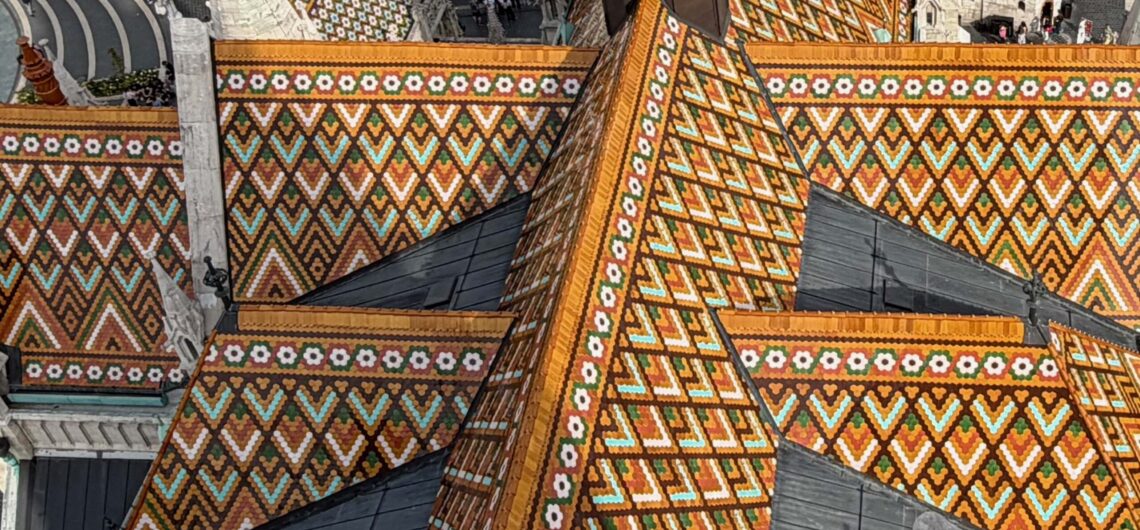
From a distance, the roof of Matthias Church looks almost like a huge piece of patterned fabric stretched across the building. Diamonds, zigzags and bands of colour run over its steep surfaces, creating a pattern that has become inseparable from the church itself. Up close, all that geometry comes down to something much simpler.

One ceramic tile. Then another. And another. The colourful tiles were produced by the famous Zsolnay factory in Pécs, and they belong to one of the most fascinating chapters in the long history of Matthias Church. Because although the church has medieval origins, the roof we recognise today tells a much more recent story.

If you’d like to explore the full history of the building, from its medieval beginnings to the details we see today, you can read my guide to Matthias Church in Budapest.

A Medieval Church Reimagined

Matthias Church has changed many times over its long history. It has been enlarged, altered, damaged and rebuilt, and what we see today owes an enormous amount to the 19th century. In 1873, architect Frigyes Schulek began the great reconstruction that would give the church much of its present appearance. The work continued for more than two decades, and the renovated church was consecrated in 1896, when Hungary was celebrating the thousandth anniversary of the Magyar conquest of the Carpathian Basin.

Schulek wanted to recover the medieval character of the church. But 19th-century restoration was not necessarily about returning every stone and decorative detail to an exactly documented earlier state. What emerged was both restoration and reinterpretation: a 19th-century vision of a medieval Hungarian church. And the roof is one of the best places to see that story.

Medieval Inspiration, Modern Technology

This is perhaps my favourite part. Schulek was trying to create a church that looked convincingly medieval while being perfectly willing to use some of the most innovative materials of his own time.

He knew Vilmos Zsolnay, whose ceramic factory in Pécs was experimenting with new materials for architecture. Among them was pyrogranite, a particularly durable ceramic developed for exterior use and capable of withstanding difficult weather conditions. Schulek trusted the new material, and Matthias Church became one of its early architectural showcases.

So there is a wonderful contradiction above our heads. The colourful roof looks as though it belongs naturally to a medieval church, yet it is also the product of late-19th-century Hungarian design, technology and craftsmanship. Something created to evoke the past became one of the most recognisable features of modern Budapest.

A Roof That Became Part of Budapest

Today it is difficult to imagine Matthias Church without those colours. Walk around Fisherman’s Bastion and the patterned roof keeps appearing between arches, towers and stone balustrades. Approach through the streets of the Castle District and fragments of colour begin to emerge above the surrounding buildings.

From across the Danube, the individual tiles disappear completely, yet the steep roof remains part of the unmistakable silhouette of Castle Hill. This is one of the things I love about Budapest architecture. A detail can work at completely different scales.

From a distance, you see a landmark. Come closer and you see a pattern. Closer still, and the pattern becomes individual pieces of ceramic. The building changes depending on how you look at it.

197 Steps Later…

Which brings me to the slightly less glamorous part of this story. I decided to climb the Matthias Church tower. There are 197 steps to the panoramic terrace.

I remember this climb from years ago as being rather civilised, with convenient places to stop along the way. Either my memory has become extremely generous or the arrangement has changed, because this time there was a first stop after about 60 steps — followed by what felt like an endless climb up very steep stairs. But I made it.

And from above, the roof becomes something completely different. The patterns that look almost flat from the square suddenly spread out below you. Roof sections meet at unexpected angles. Turrets interrupt the geometry. The coloured tiles form enormous compositions that are almost impossible to understand from street level.

It reminded me of a story often told about another great Hungarian architect, Ödön Lechner. When someone supposedly questioned why he put so much effort into decorating parts of a roof that nobody could see from the street, he is said to have replied that God and God’s birds would see it.

Whether Lechner actually said those exact words or not, I have always loved the thought. There is something wonderful about putting beauty somewhere even when most people will never see it.

And standing above Matthias Church, looking down at all that colour and geometry, I thought about it again. Then you look beyond them and there is Budapest: Fisherman’s Bastion, the rooftops of Buda, the Danube and Pest in the distance.

It was worth the 197 steps. I reserve the right to reconsider that statement next time someone suggests I climb them again.

Why Walking Through Budapest Still Surprises Me

This is also why I still love exploring Budapest on foot. Walking gives you time to change perspective. You see Matthias Church from the square. Then from beside Fisherman’s Bastion. Then through an archway. You notice the roof between buildings. You get close enough to see individual details. And sometimes you climb 197 steps and discover that something you thought you knew looks completely different from above.

That is very much how I approach my Budapest private walking tours too. Of course we visit the famous places, but I also want to show you what connects them: the architecture, the history and the smaller details that make the city more interesting once you begin to notice them.

Budapest’s landmarks deserve to be seen. But they also deserve to be looked at.

Look Again at Something Familiar

Matthias Church is one of Budapest’s most photographed buildings. Its colourful roof has appeared in millions of photographs, postcards and holiday albums. And perhaps that familiarity is exactly why it is so easy to stop really looking at it.

Next time you are in the Castle District, look up. Look at the pattern first. Then look closer and find the individual tiles. Remember that the medieval-looking roof above you is also a story of 19th-century Budapest: of restoration, experimentation, craftsmanship and an architect using modern technology to reimagine the past.

Sometimes a familiar Budapest landmark only needs a change of perspective to become a discovery again. And sometimes that change of perspective requires 197 steps.

Explore Buda Castle With Me

If you’d like to discover Matthias Church and the Castle District this way, my Historical Buda Castle Walk explores the famous landmarks alongside the history, architecture and details that bring this part of Budapest to life.

It is a completely private walking tour, so we can adapt the route and pace around your interests — and no, climbing the 197 steps is absolutely not compulsory. You can also explore my Budapest Private Walking Tours or browse all my fully customisable Budapest private tours if you’d like to see more of the city with me.

The Roof That Makes Matthias Church Unmistakable

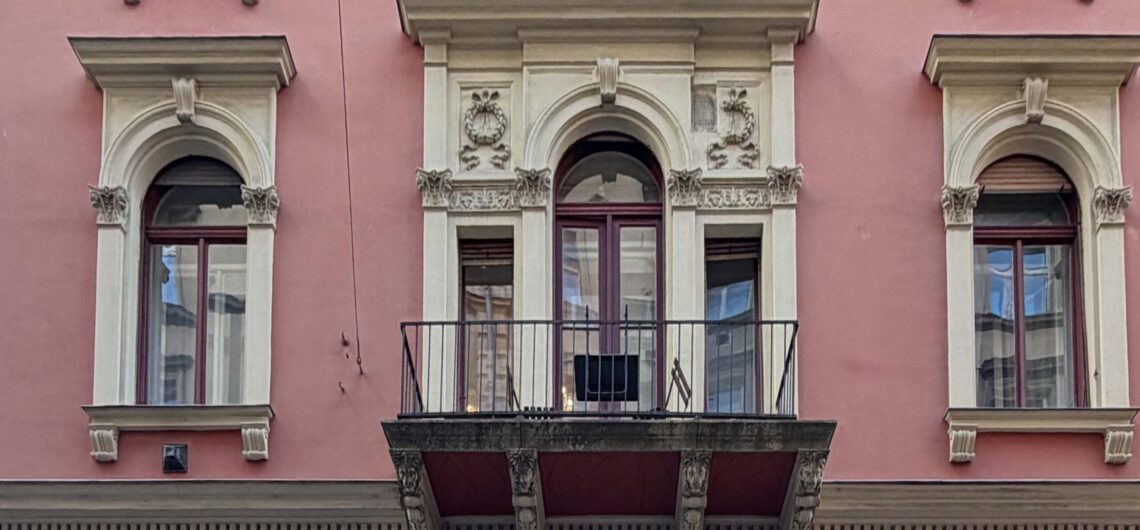
Once you start looking up in Budapest, certain details become impossible to ignore. Budapest balconies come in every imaginable shape and size, but one particular type always catches my eye: a large façade with rows and rows of windows — and just one balcony.

Sometimes it is delicate wrought iron. Sometimes it is supported by enormous stone brackets. Some are decorated with flowers, others are surprisingly simple. But there it is, sitting proudly on the façade, often directly above the main entrance.

So why just one? As with most things in architecture, there isn’t one answer that works for every building. But that balcony can be a clue to something much more interesting: the hidden hierarchy of the house behind the façade.

Not every floor was equal

Many of the grand apartment houses we see in Budapest today were built during the city’s extraordinary growth in the 19th century. And although their façades can look wonderfully harmonious, not every floor originally had the same status.

One of the most prestigious was traditionally the piano nobile, or principal floor — an architectural idea inherited from European palaces and grand residences. On Budapest apartment houses, this was often one of the lower residential floors, and its importance could be expressed on the façade through larger windows, richer decoration and, sometimes, a prominent balcony.

There was a practical reason for this hierarchy too. Before lifts became commonplace, the lower floors offered a rather attractive compromise: above some of the noise, dust and activity of the street, but without several flights of stairs between you and your front door.

So the hierarchy inside the building could become visible on the outside.

The balcony may be telling you where to look

This is where it gets interesting — because Budapest and its balconies don’t make things quite that simple. A single balcony doesn’t automatically mean “the most important person in the building lived here.”

Sometimes a balcony helps emphasise the principal floor, sometimes it marks the centre of the façade, sometimes it sits directly above the grand entrance, strengthening the symmetry of the building. And sometimes several of those ideas come together.

So I wouldn’t use balconies as a secret code for working out exactly who lived where. But I would use them as an invitation to look more closely. Look at the windows around the balcony. Are they larger or more decorated than those above? Look at the entrance below. Does everything line up? Does one part of the building seem to be asking for your attention?

The building is quietly telling you where to look.

One Idea, Dozens of Budapest Balconies

Once I started deliberately looking for these balconies, I realised just how different they are. Some have delicate wrought-iron railings. Others project dramatically over the pavement on enormous carved stone brackets. Some are restrained and elegant; others seem determined to use every decorative idea available before lunchtime.

And then, of course, there are the flowers. They belong to different periods and architectural styles, but together they reveal something I love about Budapest: even buildings that initially appear symmetrical and orderly are full of small details waiting to be noticed. This is also why I enjoy Budapest’s beautiful entrances so much. A doorway, balcony, window or piece of stonework may look purely decorative at first, but often it helps us understand how the whole façade was designed.

This is why I love exploring Budapest on foot

Last week I wrote about exploring Budapest on foot, and this is exactly the sort of thing I meant. Of course, on my Budapest private walking tours we see the famous sights. Parliament, the Castle District, St Stephen’s Basilica and the grand avenues are part of what makes Budapest extraordinary.

But walking gives us something else as well. It gives us time to notice the building between two landmarks. The doorway that happens to be open. Old lettering above a shop. A beautiful piece of stained glass. A strange face looking down from a façade. Or one balcony sitting proudly among dozens of windows.

Sometimes we stop because there is a story I want to tell. Sometimes one of my guests notices something and asks me about it. And sometimes I still stop because I’ve noticed something. After all these years, Budapest hasn’t run out of things to make me look up.

Now you’ll see them everywhere

So here’s a little challenge for your next walk through Budapest. Every now and then, stop and look at the whole façade in front of you. Is there only one balcony? Where is it? Is it above the entrance? Does it mark the centre of the building? Are the windows around it larger or more decorated? Does that floor somehow look more important than the ones above?

There may not be one simple answer. That’s part of the fun. Because Budapest becomes much more interesting when its buildings stop being a backdrop and start becoming something you can read.

And I’m afraid that now I’ve pointed out the balconies, you may start seeing them everywhere too.

If you’d like to discover Budapest and Budapest balconies this way — seeing the famous landmarks, but also the architecture, stories and little details in between — take a look at my Budapest Private Walking Tours. Every tour is completely private and can be adapted around your interests, pace and curiosity.

Sometimes the most interesting Budapest stories are hiding in plain sight.

One Balcony, a Whole Budapest Story

Exploring Budapest on foot is about much more than walking from one famous sight to another. Some of my favourite moments happen in between: turning into a quiet street, disappearing through an archway, finding a hidden garden or noticing a detail on a building I must have passed a hundred times before.

After many years of guiding in Budapest, I still think walking is one of the best ways to understand the city. Not because you can see everything on foot — you certainly can’t — but because walking gives you time to notice how Budapest changes around you. And sometimes the walk itself becomes the story.

Budapest is a city of contrasts

Walk through the Buda Castle District and you can move from grand monuments to tiny streets in a matter of minutes. Matthias Church and Fisherman’s Bastion may be just around the corner, but so are quiet courtyards, old doorways, gardens and passages where the city suddenly feels very different.

That contrast is one of the things I love most about Budapest. There is the monumental city everybody comes to see, but there is another Budapest hiding between those famous places. Sometimes you have to walk a little more slowly to find it.

I love taking small detours through the hidden gardens in Buda Castle, or choosing a street simply because there is a beautiful doorway at the end of it. Budapest has some extraordinary beautiful entrances, but what I enjoy even more is the feeling that you never quite know what might be waiting on the other side.

Why exploring Budapest on foot is different

Of course, there are landmarks I never get tired of. Walking towards the Danube and suddenly seeing the Chain Bridge ahead of you still makes me happy. Crossing from Buda to Pest changes the whole perspective of the city. The streets become busier, the architecture changes, and before long you might find yourself under an elegant arcade, looking into a courtyard or stopping for coffee.

But I don’t think Budapest should feel like a checklist. Parliament. Tick. Basilica. Tick. Castle. Tick. You could see all of those places and still miss something important about the city.

For me, exploring Budapest is just as much about what happens between them. It might be a beautiful façade you weren’t looking for. A tiny architectural detail high above street level. A tram rattling past. An unexpected patch of green. Or simply a street that makes you wonder where it goes.

That is why one of my favourite walks in Budapest follows the Danube and some of the smaller streets around it rather than racing from attraction to attraction.

There is always another way to get somewhere.

Looking up is compulsory

This may be the only strict rule on my walking tours. Budapest rewards people who look up. Faces, birds, flowers and strange creatures hide on façades. Stained glass glows above doorways. Ceramic details appear on rooftops. Buildings that seem quite ordinary at street level suddenly become extraordinary when you stop and look properly.

Architecture is one of my great loves, and walking gives us the freedom to stop when something catches our eye — whether or not it was originally part of the plan. That is also why I enjoy sharing places such as the Róth Miksa Memorial House, where Budapest’s love of colour, glass and decoration can be explored on a much more intimate scale.

Sometimes those unplanned stops become the moments people remember most. And once you start looking up, you may notice something curious about Budapest’s balconies — including why some grand façades seem to have only one.

A private walk doesn’t need to follow a script

This is probably what I love most about giving private walking tours in Budapest. Every guest arrives with different interests. Some want history. Some love architecture. Others want food, photography, Jewish heritage, Art Nouveau, the story of the Communist period — or simply to understand what it feels like to live in Budapest today.

And sometimes people don’t know exactly what they’re interested in until we start walking. That is where a private tour becomes fun. We can linger somewhere because a conversation has become interesting. We can change direction because you spotted something across the street. We can stop for coffee. We can take a tram for a few stops when it makes sense. We can spend longer in Buda, wander deeper into Pest, or completely rearrange the day around something you suddenly decide you would love to see.

There is an itinerary, of course. But Budapest doesn’t always have to behave itself and stick to it.

Sometimes you need the tram

I love walking. I do. But I am not ideologically opposed to public transport. Budapest’s trams, buses and metro are part of the city, and sometimes hopping aboard for a few stops is exactly what a walking tour needs. It saves time, gives tired feet a little rest and lets us move between neighbourhoods without losing that feeling of being in Budapest.

On a longer day, such as my Grand Budapest Walk, combining walking with public transport means we can explore much more while still experiencing the city at street level. And there is something rather wonderful about looking through a tram window and recognising the places you’ve just walked through.

Come walk Budapest with me

After all these years, I still discover things here. A building catches the light differently. A doorway is open that was closed yesterday. A courtyard suddenly becomes accessible. I notice a detail I’ve somehow missed before.

That is one of the reasons I haven’t become bored with Budapest — and why exploring Budapest on foot still feels different from one day to the next. The famous sights matter. Of course they do. But I hope that after spending a few hours together, you’ll remember more than the landmarks. Perhaps you’ll remember the little street we turned into for no particular reason. The garden behind the wall. The building you nearly walked past. The coffee we stopped for. Or the conversation we were having when we crossed the Danube.

Because sometimes the best way to discover Budapest is simply to start walking and see where the city takes us.

If that sounds like your kind of Budapest, all my fully customisable Budapest private tours can be adapted around the places, stories and experiences that interest you most.

Come walk Budapest with me.

Walk Budapest With Me

Budapest in early autumn is one of my favourite versions of the city. The intense heat of summer begins to fade, the light becomes softer, café terraces are still busy and the city’s parks and gardens are mostly green, with just the first hints of autumn colour. September feels like a season in between — and for exploring Budapest on foot, that can be rather wonderful.

There is still plenty of summer in the city. People sit outside with their coffee, boats move along the Danube and Budapest’s parks are nowhere near ready to turn completely golden. But the mornings feel a little fresher, the shadows grow longer and every now and then you notice the first fallen leaves under your feet.

For me, this is when Budapest becomes especially enjoyable to explore slowly. You can spend hours walking without the exhausting heat of midsummer, stop at a terrace when you feel like it, wander through a garden or take a detour down a street that looks interesting. And those unplanned moments are often where Budapest becomes most memorable.

The weather is made for walking

If you ask me for one of the best reasons to visit Budapest in September, this would be very high on my list: you can walk. A lot.

Budapest is a city that rewards walking. Of course there are trams, buses and a wonderfully useful metro system, but some of my favourite discoveries are found between the places you planned to see: an Art Nouveau doorway, a beautiful courtyard glimpsed through an open gate, a tiny café, an unexpected view of the Danube or a quiet street just a few minutes away from one of the city’s famous landmarks.

September weather in Budapest can still be beautifully warm during the day, while mornings and evenings gradually become cooler. There are no guarantees — Budapest weather has never shown much interest in following my instructions — but early autumn usually makes spending several hours outside considerably more appealing than during the hottest weeks of summer.

It is also one of my favourite seasons for a private Budapest walking tour. Without having to escape the midday heat quite so urgently, we can take our time, follow an interesting detour and combine the major sights with some of the smaller details and stories that are so easy to miss when you’re simply moving from one landmark to the next.

Budapest hasn’t said goodbye to summer yet

Perhaps this is what I like most about September: Budapest still feels alive outdoors.

Café and restaurant terraces are busy, people linger beside the Danube and the city’s parks and gardens are still surprisingly green. Flowers haven’t entirely disappeared, trees are still full of leaves and on a sunny afternoon it can feel as though summer has decided to stay for another few weeks.

But there are little signs that something is changing. The light is warmer. A few leaves begin to turn. You might leave your hotel in sunglasses and find yourself reaching for an extra layer later in the evening. The pace of the city seems to shift almost imperceptibly.

I particularly love this time of year in Buda. Walking through the Castle District, the gardens below the Castle or the paths overlooking the Danube, you get that lovely combination of greenery, architecture and views across Pest — without yet feeling that autumn has properly taken over.

And perhaps that’s why early autumn in Budapest feels so fleeting. It isn’t quite summer anymore, but it isn’t really autumn either.

The light is different

There is something about the light in Budapest in early autumn that I notice every year. The sun sits a little lower, the shadows become longer and the warm afternoon light suddenly catches details on buildings that you may have walked past many times before. Stone façades turn golden, windows reflect the sky, and even familiar views along the Danube seem to look slightly different.

This is especially beautiful towards the end of the day. Walk along the river, through the Castle District or simply down one of the city’s ordinary streets and you will see Budapest changing as the sun moves. Sometimes it is a grand view — Parliament framed by trees, the bridges stretching across the Danube, the rooftops of Pest seen from Buda. At other times it is something much smaller: sunlight on an old doorway, shadows across a façade or the reflection of a building in a tram window.

These are often the moments I find myself stopping for. After years of guiding in Budapest, I obviously know where the famous views are. But I still love how a change in season or simply the angle of the light can make somewhere I know extremely well look different again.

And early autumn is particularly good at that. You may be heading towards one of Budapest’s famous landmarks and find yourself stopping instead for the light on a doorway, a reflection in a window or a view you hadn’t expected. Those little distractions are often my favourite part of a walk.

The city begins to breathe again

I wouldn’t describe Budapest in September as quiet. The city is still busy, the main sights are popular and on a beautiful sunny day you certainly won’t have Fisherman’s Bastion or the Castle District to yourself. But after the busiest weeks of summer, the rhythm of the city begins to change.

The days are still long enough to spend plenty of time outside, but there is less of that midsummer urgency to fit everything in before the heat becomes too much. Walking becomes easier, stopping for coffee becomes more tempting and spending an extra twenty minutes somewhere simply because you like it suddenly feels like a perfectly reasonable plan.

This is also a good time to play a little with your schedule. Some of Budapest’s most famous places are very different early in the morning or towards the end of the day, and September’s softer light makes those hours particularly beautiful. Visit the essential sights, absolutely — there is a reason they are famous — but don’t feel that every hour needs to be filled with another attraction.

Budapest is often at its best in the spaces between them. A tram ride along the Danube. A coffee on a terrace. One of the hidden gardens in Buda Castle. A market you hadn’t planned to visit. A quiet street behind a busy square. Sitting on a bench for ten minutes because the view is rather good. Early autumn gives you permission to leave a little space for those moments.

It’s a wonderful time to look beyond the obvious sights

Of course, if this is your first visit to Budapest, you should see Parliament, walk across the Chain Bridge, visit the Castle District and stand on Fisherman’s Bastion looking across the Danube. I would never tell you to skip Budapest’s famous sights simply because they are famous. They are extraordinary. But they are only part of the city.

One of the things I enjoy most on my tours is showing people what lies between those landmarks. Budapest is full of beautiful details that are surprisingly easy to miss: Art Nouveau façades decorated with flowers and animals, magnificent old doorways, hidden courtyards, tiny statues, peaceful gardens and streets you would probably never think of adding to an itinerary.

Early autumn is particularly lovely for this kind of exploring. When the weather makes walking a pleasure, there is no reason to take the shortest route from one attraction to another. We can wander through the smaller streets behind the Basilica, follow an interesting building around a corner, step inside a courtyard when the doors happen to be open or take a detour through a garden simply because it looks inviting.

Some of these places have fascinating stories. Others are simply beautiful. And sometimes that’s reason enough to stop.

This is the Budapest I particularly enjoy sharing on my private tours: not a secret city hidden away from visitors, but another layer of the city that is there all along if you know where — and how — to look.

Exploring Budapest in early autumn with a private guide

Early autumn also happens to be one of my favourite seasons for private tours in Budapest. The comfortable walking weather gives us more freedom to explore, and a day can easily combine the city’s essential sights with the smaller places and details we’ve been talking about.

That might mean starting with Parliament and St Stephen’s Basilica before wandering into quieter streets and courtyards, combining the Castle District with gardens and viewpoints, or building an itinerary around something you particularly love — architecture, history, food, Jewish heritage, photography or simply beautiful places.

My Budapest private tours are fully customisable, so there is no standard route that everyone has to follow. We can explore on foot, use Budapest’s public transport along the way, or arrange a private car and driver when that makes more sense. Most importantly, we can adjust the day to your interests, your pace and what you have already seen.

And if September gives us one of those beautiful golden afternoons, I will almost certainly suggest a detour or two.

Budapest between the seasons

Perhaps that’s what I love most about early autumn in Budapest: you don’t really have to choose between summer and autumn yet. You can sit outside with a coffee in the sunshine, walk beneath trees just beginning to change colour and watch that unmistakable September light fall across the buildings along the Danube.

If you’re visiting Budapest at this time of year, leave a little room in your plans for the unexpected. See the famous sights, absolutely — but take the longer street, stop when something catches your eye and occasionally forget about the itinerary for a while. Budapest rewards looking a little closer.

Budapest in Early Autumn

Once you start looking closely, you’ll discover animals in Budapest architecture almost everywhere. Lions guard bridges and palace gates, birds spread their wings above rooftops, while owls, bees, peacocks and strange mythical creatures hide among the decorations of buildings most people pass without a second glance.

Some are famous symbols of Budapest and Hungary. Others are so small that you could walk beneath them every day without noticing them. But once you’ve spotted a few, you’ll start seeing them everywhere.

Budapest Is Watching You

Look up while walking through Budapest and you might suddenly find a stone face staring back at you.

Architects of the late nineteenth and early twentieth centuries loved incorporating animals, plants and mythical creatures into their buildings. They weren’t always simply decorative. Animals could symbolise strength, wisdom, freedom, prosperity or protection, while others reflected the personality or purpose of the building itself.

This is one of the reasons I love exploring Budapest on foot. A building you may have passed dozens of times can suddenly reveal an entirely new story simply because you stopped and looked a little closer.

The Lions Guarding the Chain Bridge

Some of Budapest’s animals are impossible to miss. The four enormous stone lions guarding the Chain Bridge are among the most recognisable. Created by sculptor János Marschalkó, they have watched over the bridge since the nineteenth century and have become almost as iconic as the bridge itself. And yes, they do have tongues.

One of Budapest’s favourite urban legends claims that the sculptor forgot to give his lions tongues and was so humiliated when someone pointed out the mistake that he jumped into the Danube.

It’s a wonderful story. It just isn’t true. The tongues are there—you simply can’t see them easily when standing below the lions.

The Turul Above Budapest

Then there are creatures that tell a much bigger story. The Turul, a mythical bird of prey deeply connected with Hungarian legends and national identity, appears in monuments throughout the country.

One of Budapest’s most dramatic examples spreads its wings above the Danube from the Buda Castle District, a sword held in its claws.

Its elevated position makes it impossible to overlook once you know where to look, yet understanding why the Turul appears so often in Hungary opens the door to centuries of legends, history and symbolism. It’s exactly the kind of detail that turns sightseeing into storytelling.

Tiny Bees Hiding on Budapest Buildings

The smaller animals are perhaps even more fun to discover. Look closely at some of Budapest’s historic façades and you may find tiny bees incorporated into the decoration.

Why bees? They have long represented qualities such as diligence, cooperation and prosperity, making them particularly appropriate symbols for certain commercial and financial buildings. They’re also a perfect example of why Budapest rewards people who slow down. From across the street, you see an impressive façade. Move closer, and suddenly an entire world of decorative details begins to appear.

And we’ll come back to those bees another day—they deserve a story of their own.

Peacocks, Owls and Animals in Budapest Architecture

The arrival of Art Nouveau brought an extraordinary natural world to Budapest’s architecture.

Flowers curled across façades. Leaves climbed around windows. Birds appeared above entrances and colourful ceramic decoration transformed ordinary buildings into something much more imaginative.

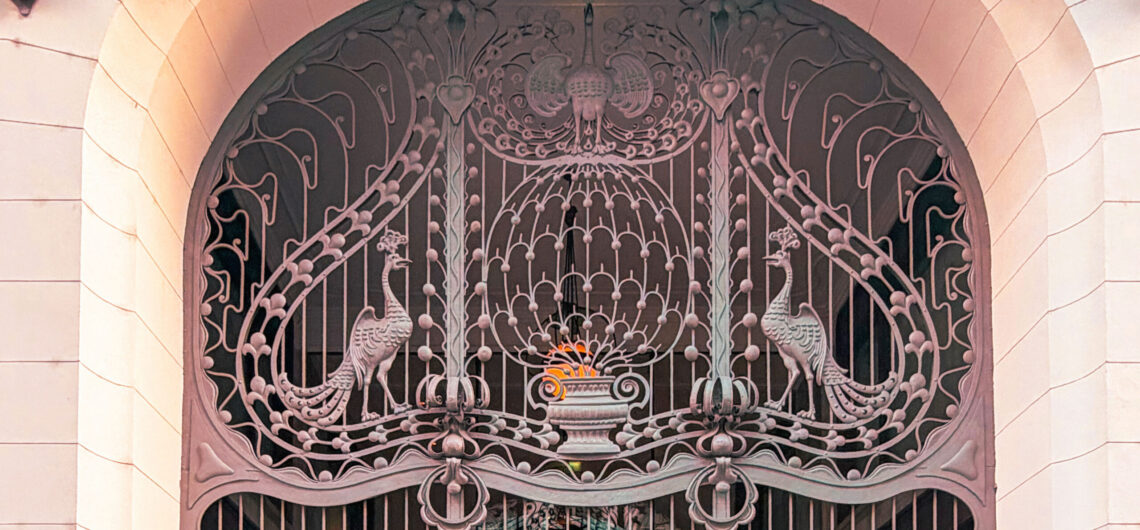
Peacocks were particularly suited to this new architectural language. Their flowing feathers, symmetry and rich colours made them perfect decorative motifs. Elsewhere, owls peer down from buildings, while birds and other creatures emerge from stone, metal, wood and colourful ceramics.

And Then There Are the Creatures You Can’t Quite Identify…

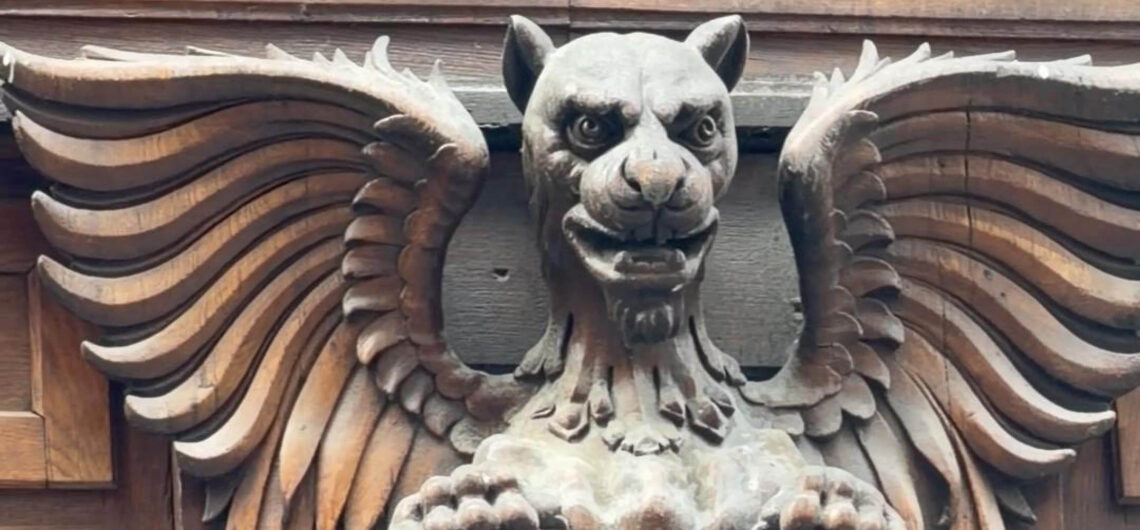
Not every animal hiding in Budapest is easy to name. Look closely at historic doorways, carved wooden panels and stone façades and you’ll encounter winged beasts, fantastic birds, strange faces and creatures that seem to belong somewhere between mythology and imagination.

Sometimes identifying them is less important than simply noticing them.

They’re reminders that the architects and craftsmen who created Budapest’s buildings weren’t only designing functional spaces. They were creating places full of personality, symbolism and sometimes even humour.

Look Up When You Walk Through Budapest

It’s easy to visit Budapest while concentrating entirely on the famous sights.

Parliament. St. Stephen’s Basilica. Buda Castle. The Chain Bridge.

They’re magnificent, and of course they’re worth seeing. But the Budapest I love showing people exists in the spaces between those landmarks too. It’s in a tiny bee above your head. A peacock decorating an entrance. An owl almost hidden behind leaves. A strange stone creature staring down from a building.

Once you begin noticing these details, walking through Budapest becomes something of a treasure hunt.

And perhaps that’s one of the things I enjoy most about being a private guide: helping people see not only what they’re looking at, but the details and stories they might otherwise have walked straight past.

Discover Budapest One Detail at a Time

Every private tour I create is different because every guest notices different things.

Some people are fascinated by architecture. Others love history, Art Nouveau, Jewish heritage, food, photography or simply discovering beautiful places away from the busiest tourist routes.

That’s why my Budapest private tours are fully customisable. We can visit the city’s essential landmarks, but we can also slow down, wander into quieter streets and look for the small details that make Budapest unforgettable.

Because sometimes the most memorable story of the day isn’t waiting inside a museum. Sometimes it’s been watching you from above the whole time.

Budapest Is Watching You 👀

Budapest Art Nouveau is one of the city’s great architectural treasures — and one of the reasons I fell in love with Budapest.

Some people visit the city for Parliament, others for the thermal baths or famous cafés. While I love all of those, I’ve always been fascinated by Budapest’s Art Nouveau buildings: the colours, flowing lines, stained glass and symbolism hidden in seemingly ordinary details.

More importantly, they invite us to slow down and look closer.

Every year on 10 June, International Art Nouveau Day celebrates this extraordinary artistic movement around the world. But in Budapest, you can discover its legacy every day simply by knowing where — and how — to look.

What Is Art Nouveau?

Art Nouveau emerged across Europe around the turn of the 20th century as a reaction against the rigid styles that had dominated architecture and design for centuries.

Instead of straight lines and strict symmetry, Art Nouveau embraced nature.

Flowers, leaves, peacocks, butterflies, vines, and flowing curves became the defining elements of a new artistic language. Architects, artists, and craftsmen wanted beauty to be part of everyday life, not something reserved for museums. In Budapest, this movement found a particularly unique expression.

The Hungarian Secession

In Hungary, Art Nouveau is generally known as Szecesszió, or Secession. Some Hungarian architects went further, developing a particularly distinctive national expression that combined international Art Nouveau ideas with Hungarian folk motifs, Eastern influences and innovative materials.

Colourful Zsolnay ceramics, floral decorations inspired by Hungarian embroidery, and rich symbolism became hallmarks of the style. The result is something that feels both international and unmistakably Hungarian.

When visitors explore Budapest, they often recognise the grand buildings. What they don’t always realise is that some of the city’s most beautiful stories are hidden in the details.

One architect played a particularly important role in developing this distinctly Hungarian style: Ödön Lechner. Inspired by Hungarian decorative traditions and the possibilities of colourful Zsolnay ceramics, he created buildings with an architectural language of their own. Look closely at his work and you’ll begin to recognise his signature in the curved windows, elaborate patterns and extraordinary rooflines that make his buildings so memorable.

The Details Most Visitors Miss

One of the things I enjoy most as a guide is watching people discover Art Nouveau for the first time.

At first, they notice the building. Then they notice the details.

  • A flower carved into stone.
  • A peacock decorating an entrance gate.
  • A stained-glass window glowing in the afternoon light.
  • A wrought-iron balcony that resembles a living plant.

Once you start looking, you begin to see these details everywhere. Art Nouveau rewards curiosity. The more closely you look, the more you discover.

Many visitors walk past these treasures without ever noticing them, which makes finding them feel even more special. These are exactly the kinds of details I love pointing out on my tours, because once someone notices the first one, they usually start spotting them everywhere.

My Favourite Art Nouveau Places in Budapest

Over the years, I’ve collected a long list of favourite Art Nouveau locations in Budapest. Some are famous, while others remain hidden gems.

Róth Miksa Memorial House

One of the most intimate Art Nouveau experiences in Budapest. The former home and workshop of stained-glass master Róth Miksa offers a fascinating glimpse into the craftsmanship behind many of the city’s most beautiful decorative elements.

Bedő House

One of Budapest’s most distinctive Art Nouveau buildings, with elegant floral motifs, decorative balconies and wonderfully intricate details that reward a closer look.

Párisi Udvar

Many visitors admire this spectacular building without realising how many decorative details cover its façade. Looking up reveals a fascinating combination of Art Nouveau, Gothic Revival, and Moorish influences.

Gresham Palace

Perhaps Budapest’s most famous Art Nouveau building, the former apartment palace features beautiful ironwork, mosaics, stained glass, and the famous peacock motifs that have become symbols of Hungarian Art Nouveau.

Ráth György Villa

A hidden treasure for anyone interested in decorative arts. The villa offers beautifully preserved interiors and an excellent introduction to the artistic world of the period.

Sonnenberg House

One of Budapest’s lesser-known Art Nouveau masterpieces. Its ongoing restoration highlights the importance of preserving these architectural treasures for future generations.

Explore Budapest Art Nouveau With Me

If these buildings and details fascinate you as much as they fascinate me, my Budapest Art Nouveau private walking tour is a wonderful way to discover them in context.

Rather than simply moving from one beautiful façade to another, we’ll look at the ideas, symbols, materials and personalities behind Hungarian Art Nouveau — and at the smaller details that are so easy to walk past without noticing.

The tour is private and fully customisable, so we can shape the route around the aspects of Art Nouveau, architecture and design that interest you most.

Budapest Rewards Curiosity

More than a century after these buildings were created, they continue to inspire visitors from around the world.

  • Their flowers still bloom in stone.
  • Their stained glass still catches the sunlight.
  • Their peacocks still watch over busy city streets.
  • And their stories are still waiting to be discovered.

If you’re planning a visit to Budapest, I encourage you to look beyond the famous landmarks and take a closer look at the details. You might be surprised by what you find.

Because in Budapest, curiosity is almost always rewarded.

Budapest Is Hiding Secrets in Plain Sight

Every year on the 15th of March, Hungary commemorates one of the most important moments in its history: the beginning of the Revolution of 1848.

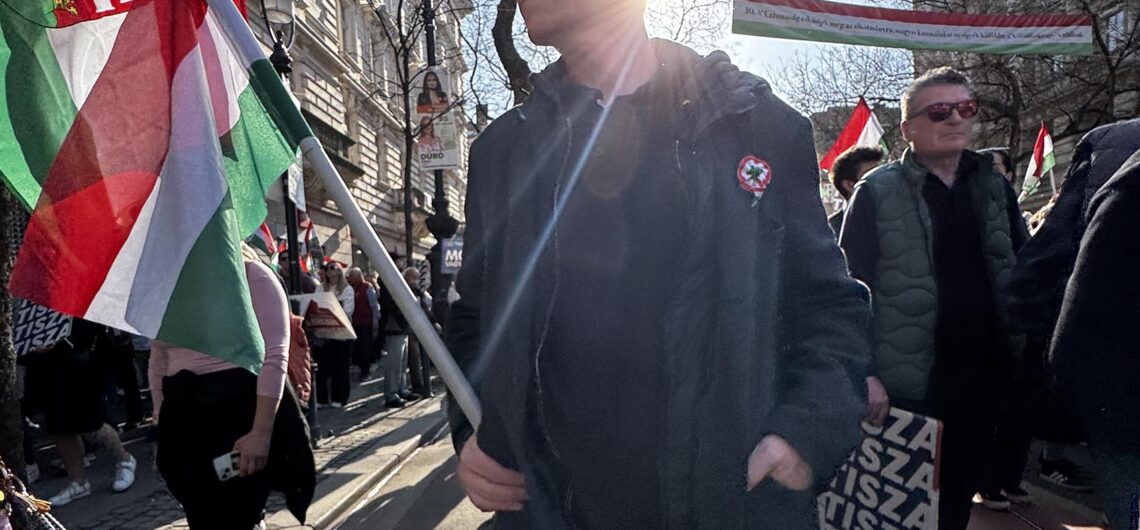
It is a day when Hungarian flags appear across Budapest, red-white-green cockades are pinned to jackets, and the city remembers the courage of those who demanded freedom.

But this national holiday is not only about remembering a historical event. It is about remembering a moment when words, ideas, and determination changed the course of a nation’s history.

The Day the Revolution Began

The events of the 15th of March, 1848 began in Pest with a group of young intellectuals known as the March Youth. Among them was the poet Sándor Petőfi, whose passionate poem Nemzeti Dal (National Song) became the voice of the revolution.

Standing before a growing crowd, Petőfi recited the poem beginning with the powerful words:

“Talpra magyar, hí a haza!”
“Rise up, Hungarians, the homeland calls!”

The poem captured the spirit of the moment. Inspired by revolutionary movements spreading across Europe in 1848, the crowd demanded political reform and national independence. Their demands were summarized in a document known as the Twelve Points, which called for:

  • freedom of the press

  • equality before the law

  • a Hungarian government independent from Vienna

  • civil rights and national sovereignty

  • the end of feudal privileges

Remarkably, the revolution in Pest began without violence. Printing presses produced copies of the Twelve Points without censorship, crowds gathered peacefully, and political prisoners were freed.

For a brief moment, it seemed that a new chapter of Hungarian history had begun.

The Hungarian Flag and the Cockade

One of the most recognizable symbols of the revolution was the red-white-green tricolour, the Hungarian national flag.

These colours had appeared earlier in Hungarian history, but during the revolution they became a powerful symbol of unity and national identity.

Even today, on March 15, many Hungarians wear a cockade made from these colours — a small circular ribbon pinned to clothing. This tradition connects modern Hungary with the revolutionaries of 1848 who wore the same symbol of patriotism.

Walking through Budapest on this day, you see flags hanging from historic buildings, bridges, and balconies across the city.

The red, white, and green colours remind people not only of the past, but also of the enduring importance of freedom. The three colours of the Hungarian flag tell a story of their own: red symbolises the blood and passion of those who fought for freedom, white represents honesty and integrity, and green reflects hope for the nation’s future.

The Revolution and Its Legacy

Although the revolution eventually led to a war with the Habsburg Empire and was ultimately suppressed in 1849, its ideals continued to shape Hungarian identity.

Many of the political and social reforms demanded in 1848 eventually became reality. More importantly, the revolution became a lasting symbol of the Hungarian desire for independence and self-determination.

Hungarian history includes several moments when people stood up for freedom.

One of the most powerful examples was the 1956 uprising against Soviet rule, another event that deeply shaped modern Budapest and the national memory.

Understanding these moments helps visitors see Budapest not only as a beautiful city, but also as a place where history was lived with extraordinary courage.

Experiencing the 15th of March in Budapest

If you happen to visit Budapest around the 15th of March, you will see a very special atmosphere in the city.

Public squares host commemorations, historic locations connected to the revolution are visited by locals, and Hungarian flags appear everywhere. The holiday is both festive and reflective — a quiet but powerful reminder of the ideals that shaped the country.

For visitors interested in the deeper layers of Hungarian history, these stories often come alive when walking through the city itself. Many of the historic streets connected to Budapest’s past — including areas like the Jewish Quarter — reveal how layers of history shaped the city we see today.

Many of the places connected to Hungary’s struggles for freedom can still be seen today — from the streets where the revolution began to the monuments remembering later events such as the 1956 uprising. Fortunately, many of these historic sites are easy to reach thanks to Budapest’s excellent public transportation system, which makes exploring the city simple for visitors.

Why This History Matters Today

One of the most moving aspects of the 15th of March is that the revolution was not only fought with weapons.

It was fought with poetry, ideas, and courage. The words spoken in the streets of Pest in 1848 continue to echo through Hungarian history, reminding people that freedom often begins with the courage to imagine a different future.

Every Hungarian flag displayed on this day carries that message forward. Whenever I walk through Budapest on the 15th of March, I can’t help wondering what the young revolutionaries of 1848 would expect from us today. Reading the Twelve Points, it is striking how timeless their message remains. The ideals of freedom, equality before the law, and responsible government still resonate deeply, reminding us that the spirit of 1848 continues to challenge and inspire every generation.

Budapest is a city where history is not only remembered — it is lived in its streets, squares, and stories. If you would like to explore these layers of history while discovering the city with a local guide, I would be delighted to show you around on one of my private tours.

March 15 Budapest 🇭🇺 Nemzeti Menet | Hungary’s National Day

Snow has a way of transforming Budapest, Budapest in winter feels noticeably different. The familiar streets grow quieter, footsteps slow down, and the city reveals a softer, more intimate side. Winter in Budapest isn’t about rushing between sights — it’s about atmosphere, details, and moments that invite you to pause.

If you’re wondering whether Budapest is worth visiting in winter, the answer is a gentle but confident yes.

A Slower Side of Beautiful Budapest in Winter

When snow falls, Budapest feels more personal. Locals linger a little longer in cafés, parks feel almost private, and even the busiest areas take on a calm rhythm. This is when the city rewards those who enjoy slow travel — walking, observing, and letting places unfold naturally.

Winter light softens the architecture, and familiar landmarks feel less crowded and more contemplative. It’s a season for wandering without a strict plan, following quiet streets instead of highlights lists.

Walking Through a Snowy City

Budapest is a city made for walking, and winter emphasises this beautifully. Snow-covered paths along the Danube, peaceful parks, and residential streets offer some of the most memorable walks of the year.

Exploring on foot allows you to notice small details — the sound of trams in the snow, steam rising from café windows, and the contrast between warm interiors and the cold outside. These moments are often missed during busier seasons.

If you enjoy discovering cities at a relaxed pace, winter walks are an ideal way to experience Budapest. You can find more ideas and inspiration on my Budapest walking tours page, where I share different ways to explore the city beyond the obvious routes.

Winter Landmarks Without the Crowds

Some of Budapest’s most iconic sights feel especially atmospheric in winter. Snow highlights the lines of historic buildings, bridges feel more dramatic against a pale sky, and viewpoints offer crisp, clear perspectives.

  • The Hungarian Parliament and its surroundings in winter
  • Budapest’s bridges and how they connect the city’s two sides
  • Scenic riverside walks along the Danube

These places take on a quieter, more reflective character when the city slows down.

Winter is also an ideal time to explore Budapest’s museums, especially smaller, less crowded places that reward curiosity and attention to detail. If you enjoy discovering hidden cultural gems, you may like my visit to the Róth Miksa Memorial House, a beautifully preserved Art Nouveau museum that offers a quiet and inspiring indoor experience.

Warm Pauses Inside

One of the joys of Budapest in winter is the rhythm between outside and inside. After a walk in the cold, stepping into a café feels especially comforting. Foggy windows, warm drinks, and unhurried conversations are all part of the winter experience.

This balance — between exploration and rest — is what makes winter travel here so rewarding. It’s not about seeing everything, but about feeling connected to the city.

Is Winter the Right Time to Visit Budapest?

Winter is perfect for travellers who:

  • Prefer fewer crowds
  • Enjoy slow, mindful travel
  • Love photography and atmosphere
  • Want a more local, authentic experience

While days are shorter and colder, the city’s charm is unmistakable. Budapest doesn’t hibernate — it simply changes pace.

Discover Budapest at Your Own Rhythm

Whether you’re visiting for the first time or returning to see the city from a new perspective, winter offers a unique opportunity to connect with Budapest on a deeper level.

If you’d like help planning a personalised experience or exploring the city through thoughtful walks, feel free to visit my Contact page. I’m always happy to help you discover Beautiful Budapest — one moment at a time.

Budapest in winter