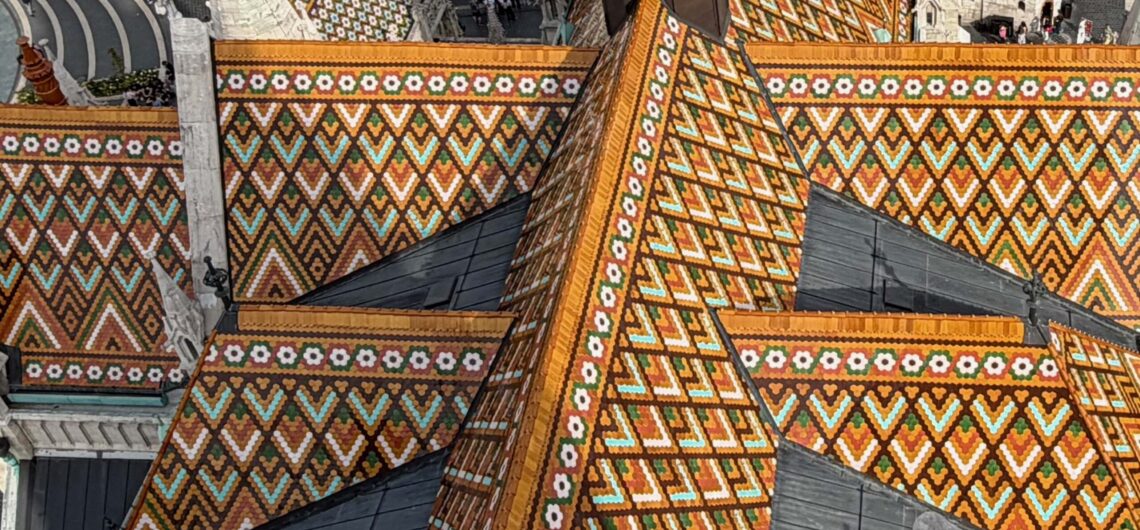
The Matthias Church roof is one of those Budapest sights I thought I knew very well. I have walked past it hundreds of times, shown it to countless guests and photographed it from almost every direction.
Then, the other day, I started looking at the tiles. Not the roof. The individual tiles. And suddenly one of the most familiar buildings in Budapest became interesting all over again.
Budapest, One Tile at a Time
From a distance, the roof of Matthias Church looks almost like a huge piece of patterned fabric stretched across the building. Diamonds, zigzags and bands of colour run over its steep surfaces, creating a pattern that has become inseparable from the church itself. Up close, all that geometry comes down to something much simpler.
One ceramic tile. Then another. And another. The colourful tiles were produced by the famous Zsolnay factory in Pécs, and they belong to one of the most fascinating chapters in the long history of Matthias Church. Because although the church has medieval origins, the roof we recognise today tells a much more recent story.
If you’d like to explore the full history of the building, from its medieval beginnings to the details we see today, you can read my guide to Matthias Church in Budapest.
A Medieval Church Reimagined
Matthias Church has changed many times over its long history. It has been enlarged, altered, damaged and rebuilt, and what we see today owes an enormous amount to the 19th century. In 1873, architect Frigyes Schulek began the great reconstruction that would give the church much of its present appearance. The work continued for more than two decades, and the renovated church was consecrated in 1896, when Hungary was celebrating the thousandth anniversary of the Magyar conquest of the Carpathian Basin.
Schulek wanted to recover the medieval character of the church. But 19th-century restoration was not necessarily about returning every stone and decorative detail to an exactly documented earlier state. What emerged was both restoration and reinterpretation: a 19th-century vision of a medieval Hungarian church. And the roof is one of the best places to see that story.
Medieval Inspiration, Modern Technology
This is perhaps my favourite part. Schulek was trying to create a church that looked convincingly medieval while being perfectly willing to use some of the most innovative materials of his own time.
He knew Vilmos Zsolnay, whose ceramic factory in Pécs was experimenting with new materials for architecture. Among them was pyrogranite, a particularly durable ceramic developed for exterior use and capable of withstanding difficult weather conditions. Schulek trusted the new material, and Matthias Church became one of its early architectural showcases.
So there is a wonderful contradiction above our heads. The colourful roof looks as though it belongs naturally to a medieval church, yet it is also the product of late-19th-century Hungarian design, technology and craftsmanship. Something created to evoke the past became one of the most recognisable features of modern Budapest.
A Roof That Became Part of Budapest
Today it is difficult to imagine Matthias Church without those colours. Walk around Fisherman’s Bastion and the patterned roof keeps appearing between arches, towers and stone balustrades. Approach through the streets of the Castle District and fragments of colour begin to emerge above the surrounding buildings.
From across the Danube, the individual tiles disappear completely, yet the steep roof remains part of the unmistakable silhouette of Castle Hill. This is one of the things I love about Budapest architecture. A detail can work at completely different scales.
From a distance, you see a landmark. Come closer and you see a pattern. Closer still, and the pattern becomes individual pieces of ceramic. The building changes depending on how you look at it.
197 Steps Later…
Which brings me to the slightly less glamorous part of this story. I decided to climb the Matthias Church tower. There are 197 steps to the panoramic terrace.
I remember this climb from years ago as being rather civilised, with convenient places to stop along the way. Either my memory has become extremely generous or the arrangement has changed, because this time there was a first stop after about 60 steps — followed by what felt like an endless climb up very steep stairs. But I made it.
And from above, the roof becomes something completely different. The patterns that look almost flat from the square suddenly spread out below you. Roof sections meet at unexpected angles. Turrets interrupt the geometry. The coloured tiles form enormous compositions that are almost impossible to understand from street level.
It reminded me of a story often told about another great Hungarian architect, Ödön Lechner. When someone supposedly questioned why he put so much effort into decorating parts of a roof that nobody could see from the street, he is said to have replied that God and God’s birds would see it.
Whether Lechner actually said those exact words or not, I have always loved the thought. There is something wonderful about putting beauty somewhere even when most people will never see it.
And standing above Matthias Church, looking down at all that colour and geometry, I thought about it again. Then you look beyond them and there is Budapest: Fisherman’s Bastion, the rooftops of Buda, the Danube and Pest in the distance.
It was worth the 197 steps. I reserve the right to reconsider that statement next time someone suggests I climb them again.
Why Walking Through Budapest Still Surprises Me
This is also why I still love exploring Budapest on foot. Walking gives you time to change perspective. You see Matthias Church from the square. Then from beside Fisherman’s Bastion. Then through an archway. You notice the roof between buildings. You get close enough to see individual details. And sometimes you climb 197 steps and discover that something you thought you knew looks completely different from above.
That is very much how I approach my Budapest private walking tours too. Of course we visit the famous places, but I also want to show you what connects them: the architecture, the history and the smaller details that make the city more interesting once you begin to notice them.
Budapest’s landmarks deserve to be seen. But they also deserve to be looked at.
Look Again at Something Familiar
Matthias Church is one of Budapest’s most photographed buildings. Its colourful roof has appeared in millions of photographs, postcards and holiday albums. And perhaps that familiarity is exactly why it is so easy to stop really looking at it.
Next time you are in the Castle District, look up. Look at the pattern first. Then look closer and find the individual tiles. Remember that the medieval-looking roof above you is also a story of 19th-century Budapest: of restoration, experimentation, craftsmanship and an architect using modern technology to reimagine the past.
Sometimes a familiar Budapest landmark only needs a change of perspective to become a discovery again. And sometimes that change of perspective requires 197 steps.
Explore Buda Castle With Me
If you’d like to discover Matthias Church and the Castle District this way, my Historical Buda Castle Walk explores the famous landmarks alongside the history, architecture and details that bring this part of Budapest to life.
It is a completely private walking tour, so we can adapt the route and pace around your interests — and no, climbing the 197 steps is absolutely not compulsory. You can also explore my Budapest Private Walking Tours or browse all my fully customisable Budapest private tours if you’d like to see more of the city with me.