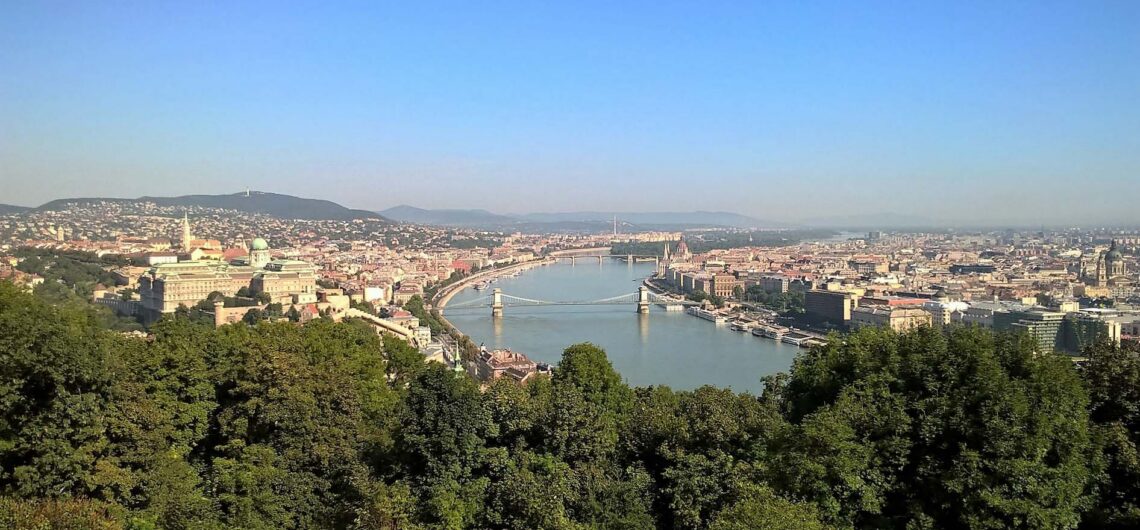
One of the questions I am often asked on my tours is why Buda and Pest feel so different. The difference between Buda and Pest becomes surprisingly obvious once you cross the Danube. Buda is the hilly western side of the Danube; Pest is the flatter eastern side.

On the Buda side, streets climb into the hills, the city feels greener and quieter, and the Castle District still follows a very different rhythm from downtown Budapest. Cross to Pest and everything seems to open out: long avenues, busy trams, cafés, shops and rows of grand 19th-century buildings.

Today we think of all of this simply as Budapest. But for most of their history, Buda and Pest were not two sides of the same city at all. They were separate places.

First Things First: Buda and Pest Really Were Separate Cities

Budapest officially came into existence in 1873, when Buda, Pest and Óbuda were united into a single city. By then, settlements had existed on both sides of the Danube for centuries, but they had developed differently. Buda grew around the hills on the western bank. Castle Hill became a royal and political centre in the Middle Ages, while other settlements spread along the river and into the surrounding hills. Across the Danube, Pest developed on much flatter land. It became increasingly important for trade and commerce and, particularly during the 19th century, expanded at extraordinary speed.

The river separated them, but geography had already given each side a very different character.

Geography Came First

This is perhaps the simplest explanation for why Buda and Pest still feel different today.

Buda is hilly. Pest is mostly flat.

That sounds almost too obvious to matter, but geography influenced how both sides developed. In Buda, roads have to climb, curve and adapt to the landscape. There are stairways, retaining walls, viewpoints and streets that suddenly disappear around a corner. Houses climb the hillsides and greenery slips between them. Pest could spread outwards across the plain. Its streets could become longer and straighter. Large boulevards and avenues could cut through the expanding city. Dense blocks of apartment buildings could grow around them.

Even today, you can often tell which side of Budapest you are on without seeing the Danube. Your feet will tell you.

Buda: Hills, History and a Different Pace

For many visitors, Buda means the Castle District. This is where you find some of Budapest’s best-known historic landmarks, including Matthias Church, the Royal Palace and the winding streets of the old town.

But Buda isn’t simply “the old side” of Budapest. That would be far too easy. The Castle District contains medieval streets and surviving fragments from earlier centuries, but much of what we see today has been rebuilt, restored and reimagined repeatedly. Matthias Church is a wonderful example. Its origins go back to the Middle Ages, but its appearance today owes an enormous amount to the 19th-century reconstruction led by Frigyes Schulek. Even its extraordinary colourful tiled roof tells a much more recent story than you might expect.

That mixture of periods is one of the reasons I enjoy walking here. Buda doesn’t present its history in a neat chronological order. Medieval, Ottoman, Habsburg, 19th-century and 20th-century Budapest all sit surprisingly close together.

And beyond the Castle District, Buda changes again. There are residential neighbourhoods, wooded hills, gardens and quieter streets. The city feels less dense. Sometimes you can almost forget that Pest, with all its noise and movement, is just across the river.

If this is the Budapest that interests you most, my Historical Buda Castle Walk explores these layers in much more detail.

Pest: The City Spreads Out

Then you cross the Danube. Pest feels different almost immediately. It is flatter, denser and more urban, and much of the cityscape visitors associate with Budapest today took shape during the extraordinary growth of the 19th century.

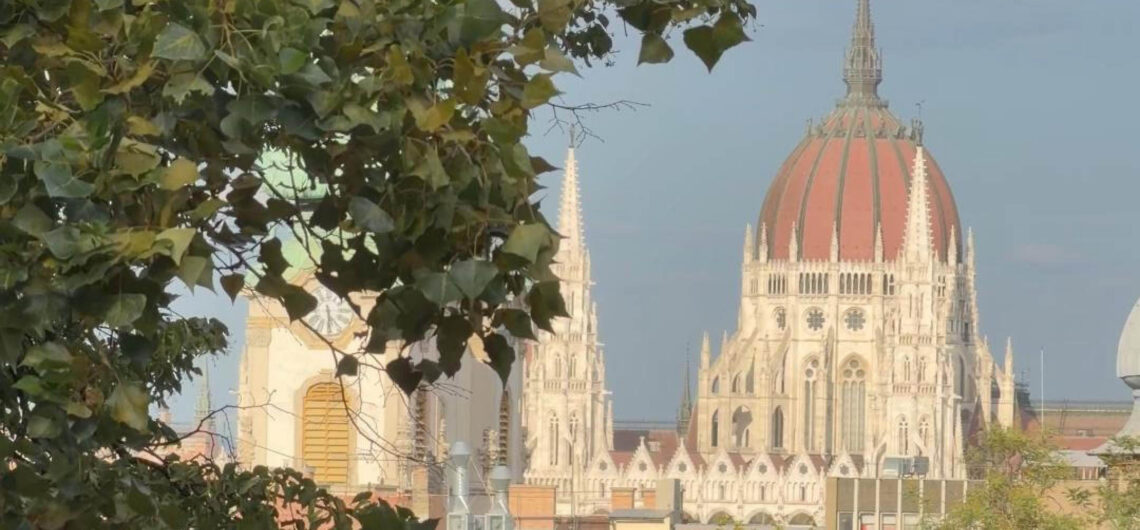
This is the Budapest of grand avenues and apartment houses, cafés, theatres, shops and trams. It is where you find the Hungarian Parliament, St Stephen’s Basilica, Andrássy Avenue and the Hungarian State Opera House.

Architects such as Miklós Ybl helped give this rapidly growing city its sense of confidence and grandeur. Later, Ödön Lechner and others began asking an even more interesting question: could Budapest develop an architectural language of its own? We will return to those gentlemen another day. They deserve considerably more than one paragraph.

But architecture is only part of Pest’s character. This was also the commercial, cultural and increasingly cosmopolitan heart of the growing city. That energy hasn’t disappeared. Walk through Pest today and you still encounter markets, cafés, shops, offices, theatres and restaurants woven into the everyday life of the centre.

My Best of Pest tour concentrates on this side of Budapest and is a lovely way to understand how Pest became the city we see today.

And What About Óbuda?

There is a small complication in the Buda-versus-Pest story. There were actually three cities involved. When Budapest was created in 1873, Buda and Pest were united with Óbuda, whose name literally means “Old Buda”. Óbuda lies to the north of central Buda and has an even longer history. The Roman town of Aquincum developed in this area, and traces of Roman Budapest are still visible today.

So although we usually talk about Buda and Pest, Budapest is really the result of three cities becoming one. The name simply didn’t have room for all three. And I think we can probably be grateful for that. Pestbudaó might have been difficult to market.

1873: One City, Two Very Different Characters

The unification of Buda, Pest and Óbuda came at an extraordinary moment. Budapest was growing rapidly. Bridges increasingly connected the two banks, transport improved, enormous building projects transformed the city and the approaching millennium celebrations of 1896 accelerated its development even further. The two sides became parts of one capital. But they didn’t become identical. And fortunately, they still aren’t.

There is modern architecture in Buda and ancient history beneath Pest. There are busy roads in Buda and wonderfully quiet streets in Pest. The distinction is never as simple as:

Buda = old. Pest = new.

But the different landscapes and the different ways the two sides developed have left a character you can still feel.

You Can Feel the Difference by Walking

This is one of the reasons I love exploring Budapest on foot. Crossing the Danube isn’t simply a way of getting from one attraction to another. It changes the rhythm of the walk.

Come down from Castle Hill and Buda gradually releases you towards the river. Cross one of the bridges and Pest draws you into a much denser city of façades, trams, cafés and streets. Go in the opposite direction and the effect reverses. The flat streets of Pest suddenly give way to a landscape that starts climbing.

You don’t need to know exactly where one historical settlement ended and another began. Your feet tell you. And once you begin noticing the difference, Budapest becomes much easier to understand.

Buda or Pest: Which Is Better?

This may be the easiest question of all. Neither. Or both. I love the contrast between them. Buda gives Budapest its hills, views and some of its deepest historical layers. Pest gives it much of its metropolitan energy and architectural grandeur. And the Danube gives us the space to see one from the other. From Buda, you look across towards Parliament and the Pest skyline. From Pest, Castle Hill rises above the opposite bank.

Each side makes the other more interesting. That is why, on a longer walk through Budapest, I particularly enjoy taking guests across the river. The moment you cross a bridge, you haven’t simply reached the next sight.

The city changes around you.

Two Sides. One Budapest.

Buda and Pest have shared a name for more than 150 years. Fortunately, they never became quite the same. If Buda’s winding streets and layers of history appeal to you most, my Historical Buda Castle Walk explores that side of the city in depth. If you’re more curious about the grand boulevards, architecture and everyday life of Pest, the Best of Pest stays on the other side of the river.

And if choosing between them seems impossible, don’t. My Grand Budapest Walk brings the two sides together — which, after all, is rather the point of Budapest. Cross the river when you’re here.

Budapest makes much more sense once you’ve walked both sides.
Buda vs Pest: Two Sides of Budapest

The Matthias Church roof is one of those Budapest sights I thought I knew very well. I have walked past it hundreds of times, shown it to countless guests and photographed it from almost every direction.

Then, the other day, I started looking at the tiles. Not the roof. The individual tiles. And suddenly one of the most familiar buildings in Budapest became interesting all over again.

Budapest, One Tile at a Time

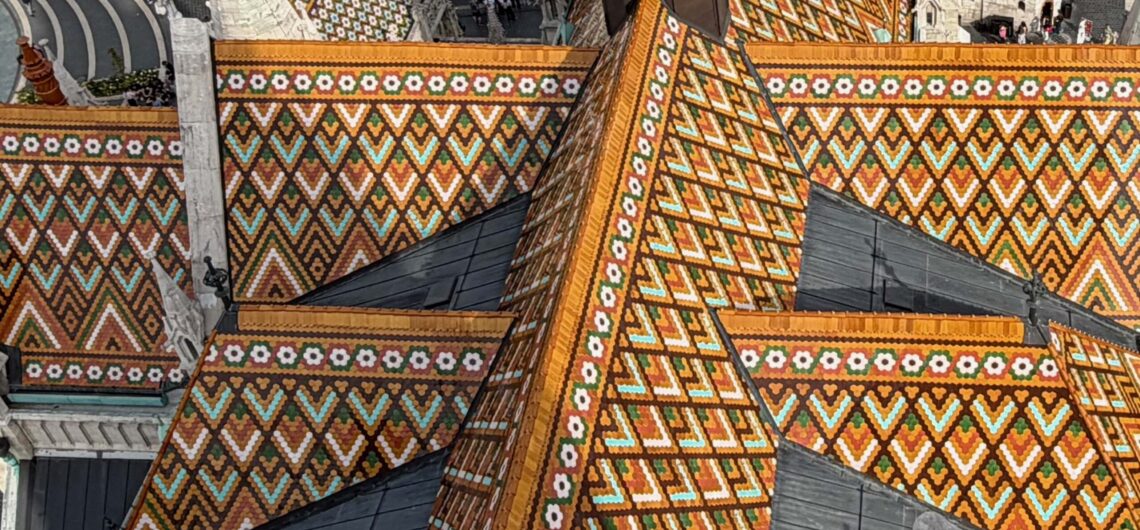
From a distance, the roof of Matthias Church looks almost like a huge piece of patterned fabric stretched across the building. Diamonds, zigzags and bands of colour run over its steep surfaces, creating a pattern that has become inseparable from the church itself. Up close, all that geometry comes down to something much simpler.

One ceramic tile. Then another. And another. The colourful tiles were produced by the famous Zsolnay factory in Pécs, and they belong to one of the most fascinating chapters in the long history of Matthias Church. Because although the church has medieval origins, the roof we recognise today tells a much more recent story.

If you’d like to explore the full history of the building, from its medieval beginnings to the details we see today, you can read my guide to Matthias Church in Budapest.

A Medieval Church Reimagined

Matthias Church has changed many times over its long history. It has been enlarged, altered, damaged and rebuilt, and what we see today owes an enormous amount to the 19th century. In 1873, architect Frigyes Schulek began the great reconstruction that would give the church much of its present appearance. The work continued for more than two decades, and the renovated church was consecrated in 1896, when Hungary was celebrating the thousandth anniversary of the Magyar conquest of the Carpathian Basin.

Schulek wanted to recover the medieval character of the church. But 19th-century restoration was not necessarily about returning every stone and decorative detail to an exactly documented earlier state. What emerged was both restoration and reinterpretation: a 19th-century vision of a medieval Hungarian church. And the roof is one of the best places to see that story.

Medieval Inspiration, Modern Technology

This is perhaps my favourite part. Schulek was trying to create a church that looked convincingly medieval while being perfectly willing to use some of the most innovative materials of his own time.

He knew Vilmos Zsolnay, whose ceramic factory in Pécs was experimenting with new materials for architecture. Among them was pyrogranite, a particularly durable ceramic developed for exterior use and capable of withstanding difficult weather conditions. Schulek trusted the new material, and Matthias Church became one of its early architectural showcases.

So there is a wonderful contradiction above our heads. The colourful roof looks as though it belongs naturally to a medieval church, yet it is also the product of late-19th-century Hungarian design, technology and craftsmanship. Something created to evoke the past became one of the most recognisable features of modern Budapest.

A Roof That Became Part of Budapest

Today it is difficult to imagine Matthias Church without those colours. Walk around Fisherman’s Bastion and the patterned roof keeps appearing between arches, towers and stone balustrades. Approach through the streets of the Castle District and fragments of colour begin to emerge above the surrounding buildings.

From across the Danube, the individual tiles disappear completely, yet the steep roof remains part of the unmistakable silhouette of Castle Hill. This is one of the things I love about Budapest architecture. A detail can work at completely different scales.

From a distance, you see a landmark. Come closer and you see a pattern. Closer still, and the pattern becomes individual pieces of ceramic. The building changes depending on how you look at it.

197 Steps Later…

Which brings me to the slightly less glamorous part of this story. I decided to climb the Matthias Church tower. There are 197 steps to the panoramic terrace.

I remember this climb from years ago as being rather civilised, with convenient places to stop along the way. Either my memory has become extremely generous or the arrangement has changed, because this time there was a first stop after about 60 steps — followed by what felt like an endless climb up very steep stairs. But I made it.

And from above, the roof becomes something completely different. The patterns that look almost flat from the square suddenly spread out below you. Roof sections meet at unexpected angles. Turrets interrupt the geometry. The coloured tiles form enormous compositions that are almost impossible to understand from street level.

It reminded me of a story often told about another great Hungarian architect, Ödön Lechner. When someone supposedly questioned why he put so much effort into decorating parts of a roof that nobody could see from the street, he is said to have replied that God and God’s birds would see it.

Whether Lechner actually said those exact words or not, I have always loved the thought. There is something wonderful about putting beauty somewhere even when most people will never see it.

And standing above Matthias Church, looking down at all that colour and geometry, I thought about it again. Then you look beyond them and there is Budapest: Fisherman’s Bastion, the rooftops of Buda, the Danube and Pest in the distance.

It was worth the 197 steps. I reserve the right to reconsider that statement next time someone suggests I climb them again.

Why Walking Through Budapest Still Surprises Me

This is also why I still love exploring Budapest on foot. Walking gives you time to change perspective. You see Matthias Church from the square. Then from beside Fisherman’s Bastion. Then through an archway. You notice the roof between buildings. You get close enough to see individual details. And sometimes you climb 197 steps and discover that something you thought you knew looks completely different from above.

That is very much how I approach my Budapest private walking tours too. Of course we visit the famous places, but I also want to show you what connects them: the architecture, the history and the smaller details that make the city more interesting once you begin to notice them.

Budapest’s landmarks deserve to be seen. But they also deserve to be looked at.

Look Again at Something Familiar

Matthias Church is one of Budapest’s most photographed buildings. Its colourful roof has appeared in millions of photographs, postcards and holiday albums. And perhaps that familiarity is exactly why it is so easy to stop really looking at it.

Next time you are in the Castle District, look up. Look at the pattern first. Then look closer and find the individual tiles. Remember that the medieval-looking roof above you is also a story of 19th-century Budapest: of restoration, experimentation, craftsmanship and an architect using modern technology to reimagine the past.

Sometimes a familiar Budapest landmark only needs a change of perspective to become a discovery again. And sometimes that change of perspective requires 197 steps.

Explore Buda Castle With Me

If you’d like to discover Matthias Church and the Castle District this way, my Historical Buda Castle Walk explores the famous landmarks alongside the history, architecture and details that bring this part of Budapest to life.

It is a completely private walking tour, so we can adapt the route and pace around your interests — and no, climbing the 197 steps is absolutely not compulsory. You can also explore my Budapest Private Walking Tours or browse all my fully customisable Budapest private tours if you’d like to see more of the city with me.

The Roof That Makes Matthias Church Unmistakable

Exploring Budapest on foot is about much more than walking from one famous sight to another. Some of my favourite moments happen in between: turning into a quiet street, disappearing through an archway, finding a hidden garden or noticing a detail on a building I must have passed a hundred times before.

After many years of guiding in Budapest, I still think walking is one of the best ways to understand the city. Not because you can see everything on foot — you certainly can’t — but because walking gives you time to notice how Budapest changes around you. And sometimes the walk itself becomes the story.

Budapest is a city of contrasts

Walk through the Buda Castle District and you can move from grand monuments to tiny streets in a matter of minutes. Matthias Church and Fisherman’s Bastion may be just around the corner, but so are quiet courtyards, old doorways, gardens and passages where the city suddenly feels very different.

That contrast is one of the things I love most about Budapest. There is the monumental city everybody comes to see, but there is another Budapest hiding between those famous places. Sometimes you have to walk a little more slowly to find it.

I love taking small detours through the hidden gardens in Buda Castle, or choosing a street simply because there is a beautiful doorway at the end of it. Budapest has some extraordinary beautiful entrances, but what I enjoy even more is the feeling that you never quite know what might be waiting on the other side.

Why exploring Budapest on foot is different

Of course, there are landmarks I never get tired of. Walking towards the Danube and suddenly seeing the Chain Bridge ahead of you still makes me happy. Crossing from Buda to Pest changes the whole perspective of the city. The streets become busier, the architecture changes, and before long you might find yourself under an elegant arcade, looking into a courtyard or stopping for coffee.

But I don’t think Budapest should feel like a checklist. Parliament. Tick. Basilica. Tick. Castle. Tick. You could see all of those places and still miss something important about the city.

For me, exploring Budapest is just as much about what happens between them. It might be a beautiful façade you weren’t looking for. A tiny architectural detail high above street level. A tram rattling past. An unexpected patch of green. Or simply a street that makes you wonder where it goes.

That is why one of my favourite walks in Budapest follows the Danube and some of the smaller streets around it rather than racing from attraction to attraction.

There is always another way to get somewhere.

Looking up is compulsory

This may be the only strict rule on my walking tours. Budapest rewards people who look up. Faces, birds, flowers and strange creatures hide on façades. Stained glass glows above doorways. Ceramic details appear on rooftops. Buildings that seem quite ordinary at street level suddenly become extraordinary when you stop and look properly.

Architecture is one of my great loves, and walking gives us the freedom to stop when something catches our eye — whether or not it was originally part of the plan. That is also why I enjoy sharing places such as the Róth Miksa Memorial House, where Budapest’s love of colour, glass and decoration can be explored on a much more intimate scale.

Sometimes those unplanned stops become the moments people remember most. And once you start looking up, you may notice something curious about Budapest’s balconies — including why some grand façades seem to have only one.

A private walk doesn’t need to follow a script

This is probably what I love most about giving private walking tours in Budapest. Every guest arrives with different interests. Some want history. Some love architecture. Others want food, photography, Jewish heritage, Art Nouveau, the story of the Communist period — or simply to understand what it feels like to live in Budapest today.

And sometimes people don’t know exactly what they’re interested in until we start walking. That is where a private tour becomes fun. We can linger somewhere because a conversation has become interesting. We can change direction because you spotted something across the street. We can stop for coffee. We can take a tram for a few stops when it makes sense. We can spend longer in Buda, wander deeper into Pest, or completely rearrange the day around something you suddenly decide you would love to see.

There is an itinerary, of course. But Budapest doesn’t always have to behave itself and stick to it.

Sometimes you need the tram

I love walking. I do. But I am not ideologically opposed to public transport. Budapest’s trams, buses and metro are part of the city, and sometimes hopping aboard for a few stops is exactly what a walking tour needs. It saves time, gives tired feet a little rest and lets us move between neighbourhoods without losing that feeling of being in Budapest.

On a longer day, such as my Grand Budapest Walk, combining walking with public transport means we can explore much more while still experiencing the city at street level. And there is something rather wonderful about looking through a tram window and recognising the places you’ve just walked through.

Come walk Budapest with me

After all these years, I still discover things here. A building catches the light differently. A doorway is open that was closed yesterday. A courtyard suddenly becomes accessible. I notice a detail I’ve somehow missed before.

That is one of the reasons I haven’t become bored with Budapest — and why exploring Budapest on foot still feels different from one day to the next. The famous sights matter. Of course they do. But I hope that after spending a few hours together, you’ll remember more than the landmarks. Perhaps you’ll remember the little street we turned into for no particular reason. The garden behind the wall. The building you nearly walked past. The coffee we stopped for. Or the conversation we were having when we crossed the Danube.

Because sometimes the best way to discover Budapest is simply to start walking and see where the city takes us.

If that sounds like your kind of Budapest, all my fully customisable Budapest private tours can be adapted around the places, stories and experiences that interest you most.

Come walk Budapest with me.

Walk Budapest With Me

Budapest in early autumn is one of my favourite versions of the city. The intense heat of summer begins to fade, the light becomes softer, café terraces are still busy and the city’s parks and gardens are mostly green, with just the first hints of autumn colour. September feels like a season in between — and for exploring Budapest on foot, that can be rather wonderful.

There is still plenty of summer in the city. People sit outside with their coffee, boats move along the Danube and Budapest’s parks are nowhere near ready to turn completely golden. But the mornings feel a little fresher, the shadows grow longer and every now and then you notice the first fallen leaves under your feet.

For me, this is when Budapest becomes especially enjoyable to explore slowly. You can spend hours walking without the exhausting heat of midsummer, stop at a terrace when you feel like it, wander through a garden or take a detour down a street that looks interesting. And those unplanned moments are often where Budapest becomes most memorable.

The weather is made for walking

If you ask me for one of the best reasons to visit Budapest in September, this would be very high on my list: you can walk. A lot.

Budapest is a city that rewards walking. Of course there are trams, buses and a wonderfully useful metro system, but some of my favourite discoveries are found between the places you planned to see: an Art Nouveau doorway, a beautiful courtyard glimpsed through an open gate, a tiny café, an unexpected view of the Danube or a quiet street just a few minutes away from one of the city’s famous landmarks.

September weather in Budapest can still be beautifully warm during the day, while mornings and evenings gradually become cooler. There are no guarantees — Budapest weather has never shown much interest in following my instructions — but early autumn usually makes spending several hours outside considerably more appealing than during the hottest weeks of summer.

It is also one of my favourite seasons for a private Budapest walking tour. Without having to escape the midday heat quite so urgently, we can take our time, follow an interesting detour and combine the major sights with some of the smaller details and stories that are so easy to miss when you’re simply moving from one landmark to the next.

Budapest hasn’t said goodbye to summer yet

Perhaps this is what I like most about September: Budapest still feels alive outdoors.

Café and restaurant terraces are busy, people linger beside the Danube and the city’s parks and gardens are still surprisingly green. Flowers haven’t entirely disappeared, trees are still full of leaves and on a sunny afternoon it can feel as though summer has decided to stay for another few weeks.

But there are little signs that something is changing. The light is warmer. A few leaves begin to turn. You might leave your hotel in sunglasses and find yourself reaching for an extra layer later in the evening. The pace of the city seems to shift almost imperceptibly.

I particularly love this time of year in Buda. Walking through the Castle District, the gardens below the Castle or the paths overlooking the Danube, you get that lovely combination of greenery, architecture and views across Pest — without yet feeling that autumn has properly taken over.

And perhaps that’s why early autumn in Budapest feels so fleeting. It isn’t quite summer anymore, but it isn’t really autumn either.

The light is different

There is something about the light in Budapest in early autumn that I notice every year. The sun sits a little lower, the shadows become longer and the warm afternoon light suddenly catches details on buildings that you may have walked past many times before. Stone façades turn golden, windows reflect the sky, and even familiar views along the Danube seem to look slightly different.

This is especially beautiful towards the end of the day. Walk along the river, through the Castle District or simply down one of the city’s ordinary streets and you will see Budapest changing as the sun moves. Sometimes it is a grand view — Parliament framed by trees, the bridges stretching across the Danube, the rooftops of Pest seen from Buda. At other times it is something much smaller: sunlight on an old doorway, shadows across a façade or the reflection of a building in a tram window.

These are often the moments I find myself stopping for. After years of guiding in Budapest, I obviously know where the famous views are. But I still love how a change in season or simply the angle of the light can make somewhere I know extremely well look different again.

And early autumn is particularly good at that. You may be heading towards one of Budapest’s famous landmarks and find yourself stopping instead for the light on a doorway, a reflection in a window or a view you hadn’t expected. Those little distractions are often my favourite part of a walk.

The city begins to breathe again

I wouldn’t describe Budapest in September as quiet. The city is still busy, the main sights are popular and on a beautiful sunny day you certainly won’t have Fisherman’s Bastion or the Castle District to yourself. But after the busiest weeks of summer, the rhythm of the city begins to change.

The days are still long enough to spend plenty of time outside, but there is less of that midsummer urgency to fit everything in before the heat becomes too much. Walking becomes easier, stopping for coffee becomes more tempting and spending an extra twenty minutes somewhere simply because you like it suddenly feels like a perfectly reasonable plan.

This is also a good time to play a little with your schedule. Some of Budapest’s most famous places are very different early in the morning or towards the end of the day, and September’s softer light makes those hours particularly beautiful. Visit the essential sights, absolutely — there is a reason they are famous — but don’t feel that every hour needs to be filled with another attraction.

Budapest is often at its best in the spaces between them. A tram ride along the Danube. A coffee on a terrace. One of the hidden gardens in Buda Castle. A market you hadn’t planned to visit. A quiet street behind a busy square. Sitting on a bench for ten minutes because the view is rather good. Early autumn gives you permission to leave a little space for those moments.

It’s a wonderful time to look beyond the obvious sights

Of course, if this is your first visit to Budapest, you should see Parliament, walk across the Chain Bridge, visit the Castle District and stand on Fisherman’s Bastion looking across the Danube. I would never tell you to skip Budapest’s famous sights simply because they are famous. They are extraordinary. But they are only part of the city.

One of the things I enjoy most on my tours is showing people what lies between those landmarks. Budapest is full of beautiful details that are surprisingly easy to miss: Art Nouveau façades decorated with flowers and animals, magnificent old doorways, hidden courtyards, tiny statues, peaceful gardens and streets you would probably never think of adding to an itinerary.

Early autumn is particularly lovely for this kind of exploring. When the weather makes walking a pleasure, there is no reason to take the shortest route from one attraction to another. We can wander through the smaller streets behind the Basilica, follow an interesting building around a corner, step inside a courtyard when the doors happen to be open or take a detour through a garden simply because it looks inviting.

Some of these places have fascinating stories. Others are simply beautiful. And sometimes that’s reason enough to stop.

This is the Budapest I particularly enjoy sharing on my private tours: not a secret city hidden away from visitors, but another layer of the city that is there all along if you know where — and how — to look.

Exploring Budapest in early autumn with a private guide

Early autumn also happens to be one of my favourite seasons for private tours in Budapest. The comfortable walking weather gives us more freedom to explore, and a day can easily combine the city’s essential sights with the smaller places and details we’ve been talking about.

That might mean starting with Parliament and St Stephen’s Basilica before wandering into quieter streets and courtyards, combining the Castle District with gardens and viewpoints, or building an itinerary around something you particularly love — architecture, history, food, Jewish heritage, photography or simply beautiful places.

My Budapest private tours are fully customisable, so there is no standard route that everyone has to follow. We can explore on foot, use Budapest’s public transport along the way, or arrange a private car and driver when that makes more sense. Most importantly, we can adjust the day to your interests, your pace and what you have already seen.

And if September gives us one of those beautiful golden afternoons, I will almost certainly suggest a detour or two.

Budapest between the seasons

Perhaps that’s what I love most about early autumn in Budapest: you don’t really have to choose between summer and autumn yet. You can sit outside with a coffee in the sunshine, walk beneath trees just beginning to change colour and watch that unmistakable September light fall across the buildings along the Danube.

If you’re visiting Budapest at this time of year, leave a little room in your plans for the unexpected. See the famous sights, absolutely — but take the longer street, stop when something catches your eye and occasionally forget about the itinerary for a while. Budapest rewards looking a little closer.

Budapest in Early Autumn

City Park Budapest (Városliget) is much more than a green escape from the city centre. At the end of Andrássy Avenue, you’ll find some of Budapest’s best-known museums, Széchenyi Thermal Bath, Vajdahunyad Castle, the Zoo and one of the city’s favourite places for walking, picnics and simply spending time outdoors.

I often include City Park in my Budapest tours because it brings together several different sides of the city in a relatively small area: grand architecture, Hungarian history, contemporary design and everyday local life. Whether you’re visiting Budapest for the first time or returning for a longer stay, you can spend an hour here — or easily half a day.

Why I Like City Park

City Park has been part of my Budapest for as long as I can remember. As a child, I came here to visit the Zoo and the old Vidámpark amusement park, to go ice skating — something I’ve been doing since I was about five — and, occasionally, to the Circus.

My memories of the Circus are slightly mixed. Once, a clown invited me onto the stage and apparently pretended to spank me behind my back while the entire audience laughed. I couldn’t understand what was so funny. Years later, my mother told me that perhaps the clown had actually been trying to impress her. It didn’t improve my opinion of clowns.

What I love most about City Park, though, is its familiarity. Budapest has changed enormously, and Városliget has changed with it, but I can still come here and recognise the same old trees, the same benches and places I’ve known all my life. There’s something deeply comforting and peaceful about that.

Széchenyi Thermal Bath is part of those memories too. It has always been a Budapest institution, and although today it’s one of the city’s most popular attractions, there’s still another Széchenyi if you come early enough. I love watching the regular local crowd arrive in the morning, before most visitors appear. That, to me, is still a very real Budapest experience.

And I like some of the changes too. Some of the new architecture in City Park is genuinely exciting. But on a warm summer evening, I’d probably still rather sit outside at Kertem with friends, drinking a fröccs under the trees.

What to See and Do in City Park

There are so many things to see and do in Városliget that the park can easily fill several hours. These are the places I’d particularly consider including.

Heroes’ Square

At the end of Andrássy Avenue, Heroes’ Square forms the monumental entrance to City Park. The Millennium Monument and its semicircular colonnades introduce some of the major figures and events of Hungarian history.

It’s an obvious starting point for exploring the park — but don’t stop here. City Park becomes much more interesting once you cross the little bridge and leave the grand monuments behind.

Vajdahunyad Castle

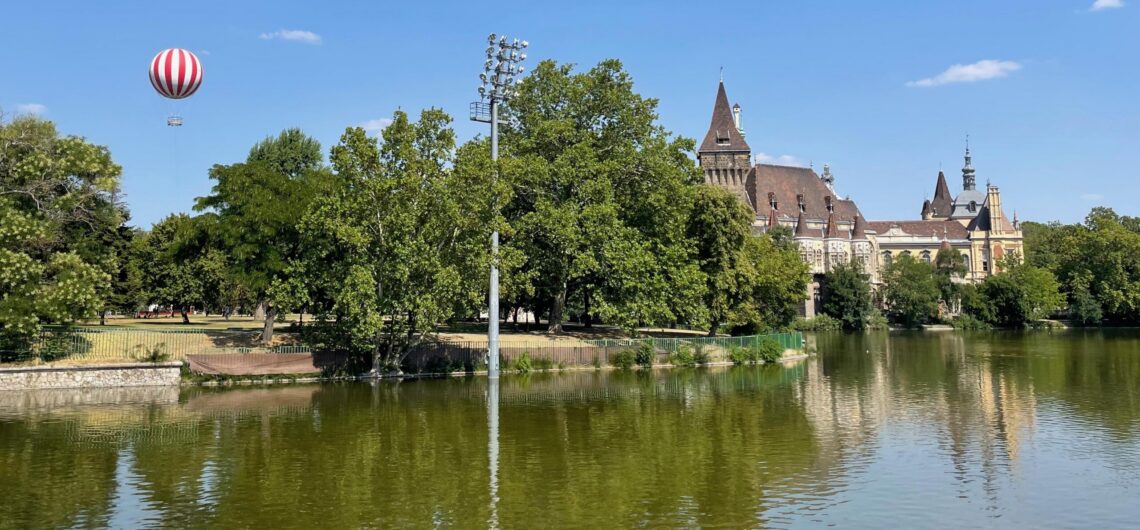
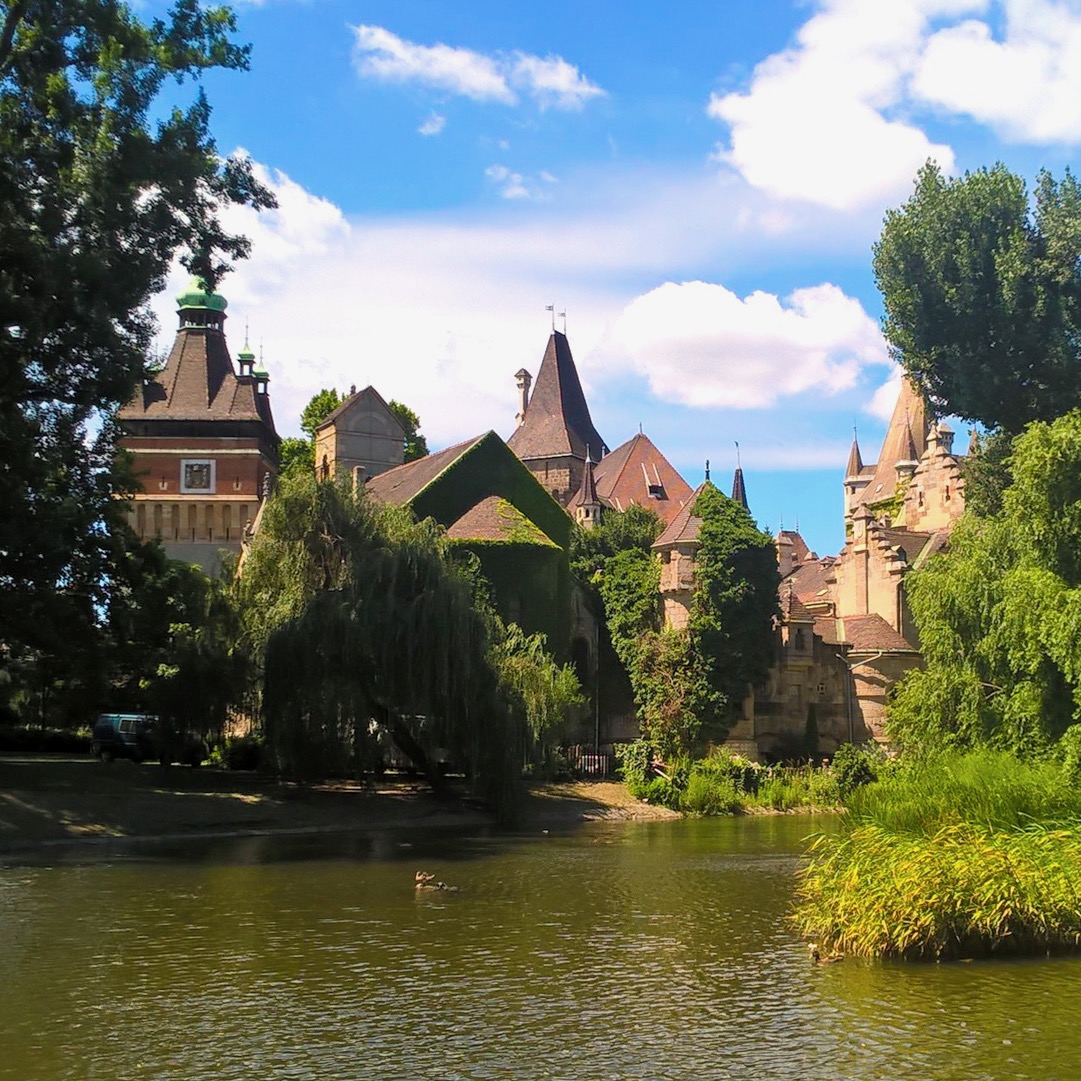
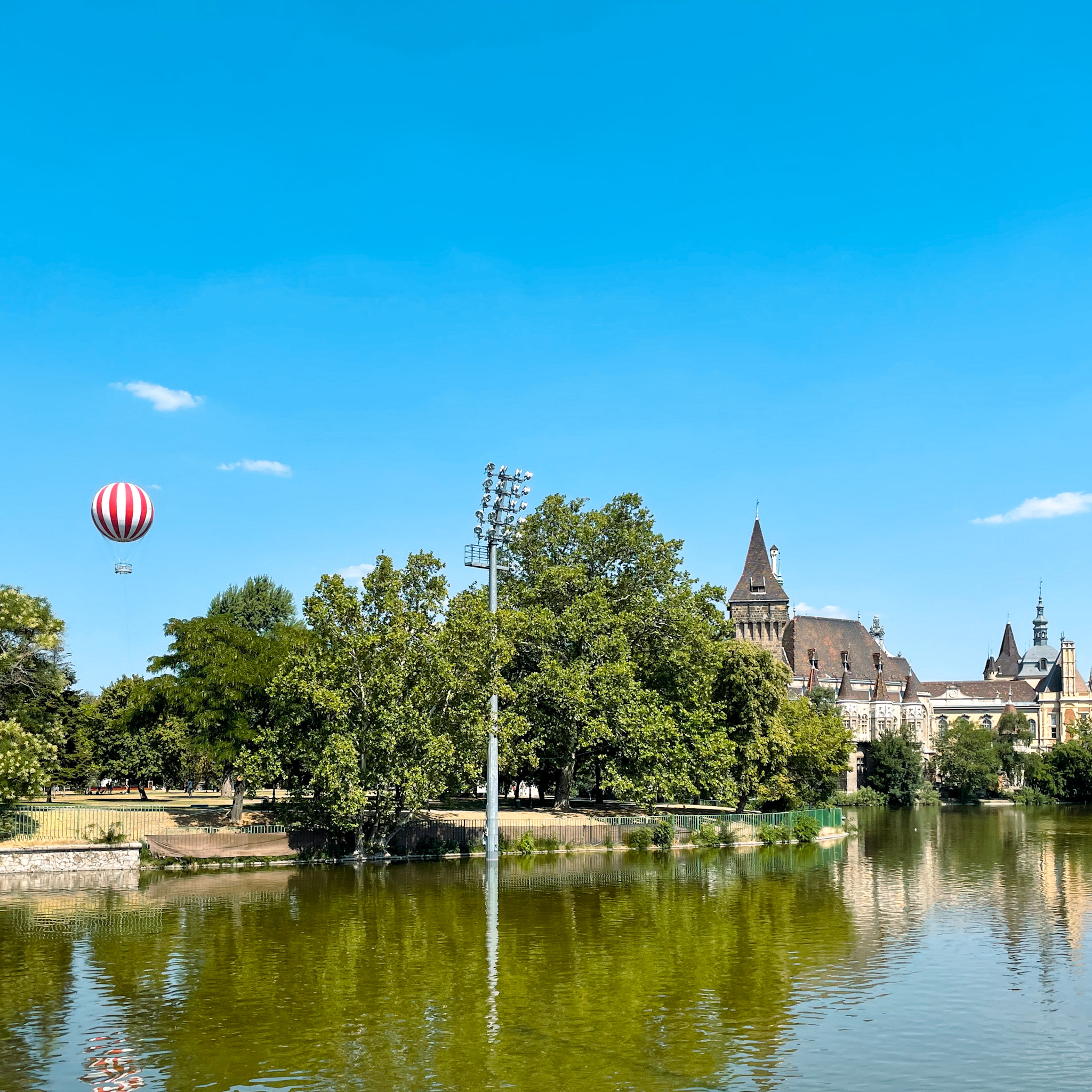
One of the most surprising buildings in City Park, Vajdahunyad Castle looks centuries older than it actually is. Originally created for Hungary’s Millennium celebrations in 1896, its different sections showcase architectural styles from various periods of Hungarian history.

Most visitors see the courtyard, but I particularly like walking around the moat to see the castle from the other side.

Széchenyi Thermal Bath

With its grand Neo-Baroque architecture and steaming outdoor pools, Széchenyi Thermal Bath is one of Budapest’s most recognisable sights and an important part of the city’s bathing culture. Even if you’re not planning to spend several hours in the pools, the building itself is worth noticing as you explore this part of the park.

House of Hungarian Music

One of the newest additions to City Park, the House of Hungarian Music brings a completely different architectural language to Városliget.

Its contemporary design, interactive exhibitions and unusual relationship between the building and surrounding trees make it much more than simply a museum for music lovers.

Museum of Fine Arts

Facing Heroes’ Square, the Museum of Fine Arts is one of Budapest’s great cultural institutions. Its permanent collection and temporary exhibitions are excellent, but I think the magnificent building itself is almost enough reason to visit. If museums are an important part of your Budapest plans, allow enough time rather than trying to squeeze a major collection into an already busy sightseeing day.

Museum of Ethnography

The Museum of Ethnography is another striking contemporary addition to City Park. Its sweeping curved form and landscaped roof have dramatically changed this part of Városliget and create an interesting contrast with the historic buildings around the park.

Budapest Zoo

Budapest Zoo has been part of City Park since the 19th century and is one of the places I associate most strongly with my own childhood. Even if you’re not visiting the Zoo itself, look at the beautiful historic entrance and the wonderful Elephant House nearby — reminders that some of the park’s most interesting architecture isn’t found among its major monuments.

The Lake, Ice Rink – and Simply Being in the Park

Not everything in City Park needs an entrance ticket. The lake changes character with the seasons: in warmer months it’s surrounded by people walking and relaxing, while in winter part of the area becomes Budapest’s famous outdoor ice rink.

I’ve been skating here since I was a child, and it’s still one of those places where City Park feels less like a tourist attraction and more like part of everyday Budapest. And sometimes the best thing to do is simply walk under the trees, sit on a bench — or feed the ducks.

Museums in City Park

City Park is also one of Budapest’s most interesting cultural areas, with several excellent museums in and around the park. The Museum of Fine Arts, House of Hungarian Music and Museum of Ethnography can all turn a walk through Városliget into a much longer cultural day. And just beyond the park, the wonderful little György Ráth Villa is one of my personal favourites for Art Nouveau and decorative arts.

If you’re deciding which ones are worth adding to your itinerary, I’ve put together a curated guide to my favourite Budapest museums.

How Much Time Do You Need in City Park?

How long to spend in City Park depends very much on what you’d like to see.

  • About one hour is enough for an introduction: start at Heroes’ Square, cross into the park and walk around Vajdahunyad Castle.
  • Two to three hours gives you time to explore at a much more relaxed pace, see more of the architecture and perhaps stop for a coffee or drink.
  • Half a day or longer makes sense if you’d like to combine the park with a museum, Széchenyi Thermal Bath or the Zoo.

I wouldn’t try to fit everything into one visit. City Park is much more enjoyable when there’s time to wander a little rather than moving quickly between attractions.

My Favourite Way to Explore City Park

My favourite way to explore City Park is to start at Heroes’ Square and then cross the little bridge into the park.

From there, I like to wander through Vajdahunyad Castle, but rather than only seeing it from the main courtyard, I always walk around to the other side of the moat. It’s one of my favourite views of the castle and somehow feels much quieter and more romantic from there.

From Vajdahunyad, I continue towards Széchenyi Thermal Bath. Even if you’re not planning to spend several hours bathing, it’s worth seeing the grand entrance and foyer. I also love the little drinking hall where you can taste Széchenyi’s thermal water — a small reminder that Budapest’s bathing culture has always been about much more than simply soaking in a hot pool.

Then I like to continue towards the old amusement park area. The Vidámpark I knew as a child has disappeared, but its beautiful historic carousel survives and is now part of the Zoo. Nearby are the wonderful Elephant House and the Art Nouveau entrance to Budapest Zoo — two details I would never hurry past.

And somewhere along the way, there should always be time to stop by the lake and feed the ducks.

That’s probably my favourite thing about this walk. It includes some of City Park’s major sights, but it doesn’t feel like moving through a checklist. There are grand monuments and beautiful buildings, but also little bridges, old memories, ducks and places where you simply stop for a while.

City Park Through the Seasons

City Park changes enormously through the year, and I don’t think there’s really a bad season to visit.

Spring and summer are when Városliget feels most like Budapest’s garden. The trees are green, people linger outdoors, and long summer evenings are perfect for simply sitting somewhere with a drink.

Autumn brings beautiful colours and a quieter atmosphere once the busiest visitor season begins to fade.

And winter gives the park an entirely different character. The ice rink becomes one of its great attractions, while the steam rising from the outdoor pools at Széchenyi makes the baths particularly atmospheric on cold days.

The monuments don’t change, of course. But the experience of the park certainly does.

City Park as Part of Your Budapest Experience

City Park works particularly well as part of a longer Budapest itinerary because the time spent here can easily be adapted to your interests. Some travellers want to focus on architecture and history, others on museums or thermal baths, while others simply enjoy seeing a greener and more relaxed side of Budapest.

My Budapest private tours are fully customisable, so City Park can be included as a short introduction or explored in much greater depth depending on what you’d most like to see.