Ödön Lechner: The Architect Who Gave Budapest a Signature
- Budapest Architecture, General, Reviews
- Art Nouveau buildings, Budapest architectural heritage, Budapest architecture, Budapest Art Nouveau, Budapest Private Tours, Budapest Walking Tours, Hungarian Art Nouveau, Hungarian Secession, Ödön Lechner, Zsolnay ceramics
Budapest has a secret signature. And once you begin exploring Ödön Lechner, you’ll start recognising his style everywhere: in the curve of a window, the shape of a roof, a colourful ceramic tile or an unusual pattern decorating a façade.
You can find it in the curve of a window, the shape of a roof, a colourful ceramic tile or an unusual pattern decorating a façade. These details belong to different buildings, sometimes in completely different parts of Budapest. Yet look closely and you begin to recognise something familiar.
The same imagination. The same delight in colour and ornament. The same determination to create something new. And behind many of these extraordinary details is one man: Ödön Lechner, the architect who helped give Budapest a distinctly Hungarian architectural language.
I’ve always loved his buildings. Recently, while filming four of them, I found myself noticing just how beautifully their shapes, patterns and colours seem to speak to one another. So rather than introduce the buildings one by one, I thought we might follow those connections.
An Architect with an Idea
At the end of the 19th century, Budapest was transforming at extraordinary speed. The city was filling with grand apartment buildings, public institutions, avenues and palaces. Much of this architecture drew inspiration from established European styles: Renaissance, Baroque, Gothic and Classical.
Ödön Lechner had another idea. He believed that Hungary could develop a modern architectural style with a character of its own. His inspiration came from several directions. Hungarian folk art and decorative traditions were important, but so were Eastern artistic influences, contemporary European architecture and the possibilities offered by new building materials.
He brought these influences together with an imagination that was entirely his own. Today, Lechner is one of the great names associated with Hungarian Art Nouveau, or Szecesszió. But perhaps the easiest way to understand his work is to look at the details.
A Shape You Begin to Recognise
One of my favourite discoveries while filming was a particular window shape. I found variations of it on different buildings. The outlines weren’t identical, but they had something in common: an unusual curve, a playful silhouette, a sense that the window was part of a larger decorative composition.
Once I’d noticed the connection, I couldn’t stop looking for others. This is one of the pleasures of Lechner’s architecture. Windows become patterns. Rooflines take on unexpected shapes. Curves appear again in ornaments, entrances and façades.
Look at the Thonet House, with its remarkable ironwork and delicate decorative details, and then at the Hungarian Geological Institute or the Postal Savings Bank. These buildings serve very different purposes, but they share something of Lechner’s architectural handwriting. It is the kind of connection that is easy to miss when you’re simply walking from one famous Budapest landmark to another. And once you notice it, you begin to see the buildings differently.
Budapest, Written in Colour by Ödön Lechner
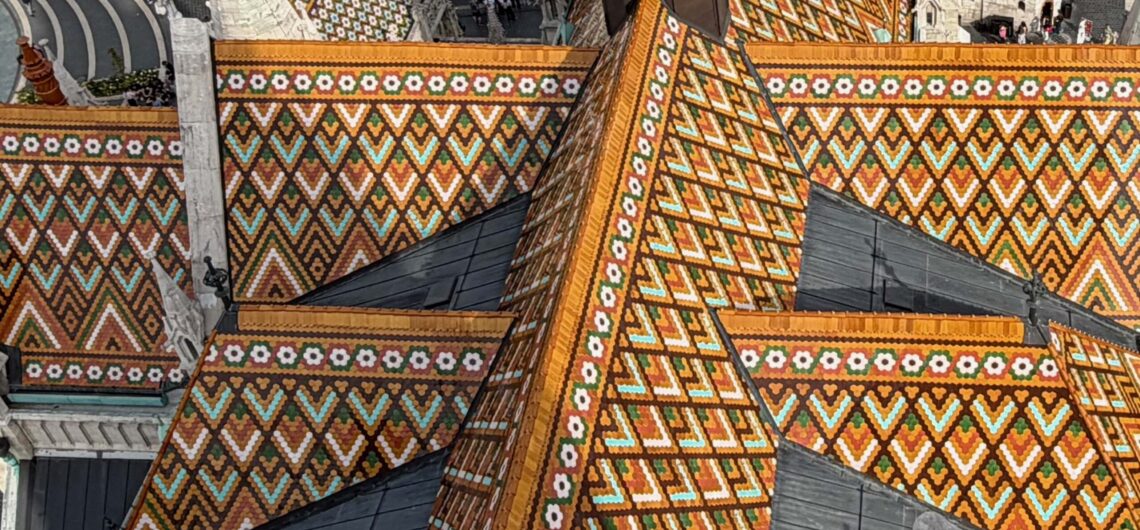
Then there are the colours. Lechner’s buildings can be wonderfully colourful, particularly where glazed ceramics become part of the architecture. He worked with the famous Zsolnay factory in Pécs, whose innovative ceramic products offered exciting possibilities for architects. Founded in the 19th century and developed into an internationally renowned ceramics manufacturer under Vilmos Zsolnay, the factory became an important part of Hungary’s architectural story. Today, its former industrial complex is home to the Zsolnay Cultural Quarter, a fascinating place to discover the craftsmanship behind some of the country’s most remarkable buildings.
Ceramics could be decorative, durable and expressive. They could cover roofs, emphasise architectural shapes and introduce colour into places where earlier generations might have expected plain stone or plaster.
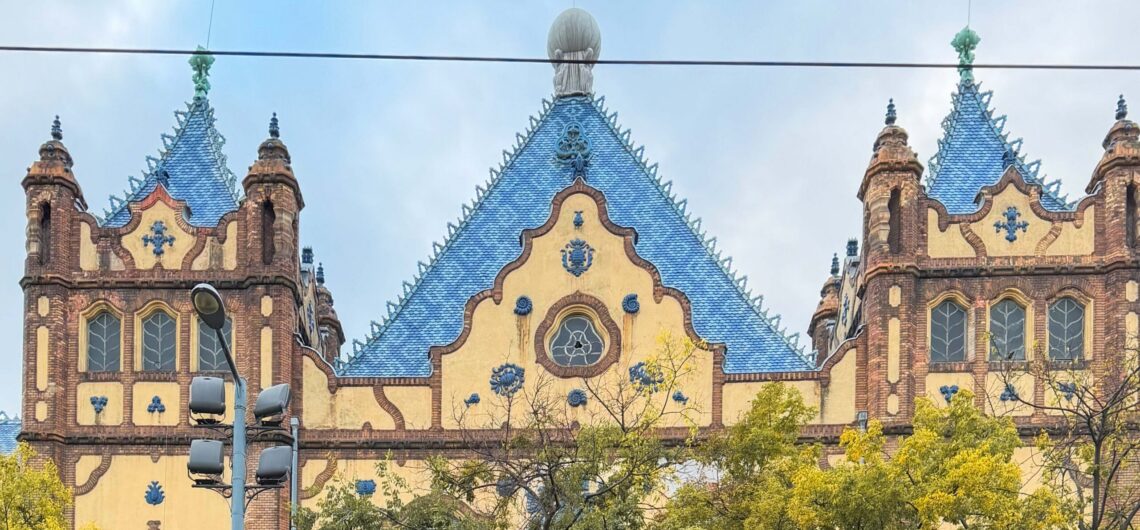
The Hungarian Geological Institute is one of my favourite examples. Its extraordinary blue roof makes the building immediately recognisable, but the real pleasure begins when you look more closely at the decorative details and the way the ceramics contribute to the whole composition.
At St Ladislaus Church in Kőbánya, the colourful roof creates a completely different impression. Here, patterns and colours contribute to the character of a church whose soaring tower and richly decorated surfaces seem almost to belong to a storybook. And yet there is something familiar about the way Lechner uses colour. The buildings are different. The imagination behind them is recognisable.
Patterns That Travel from Building to Building
One of the things I enjoy most about Budapest architecture is discovering how much thought went into details that many of us barely notice. A window surround. A piece of wrought iron. A ceramic ornament high above the street. In Lechner’s buildings, these details are rarely isolated decorations. They belong to a larger visual language.
Look at the ornamental surfaces of the Postal Savings Bank, with its lively patterns and symbolic decoration. Then look at the intricate details of the Thonet House or the colourful surfaces of the Geological Institute. You begin to recognise recurring interests: movement, rhythm, nature-inspired forms and the pleasure of turning an ordinary architectural element into something memorable.
Sometimes the connections are obvious. Sometimes they’re surprisingly subtle. That is what I find so fascinating. You can look at four buildings, each with its own purpose and personality, and still recognise the architect behind them.
Four Buildings, Four Very Different Personalities
The four buildings I filmed offer a wonderful introduction to Lechner’s Budapest.
- The Thonet House, in the heart of Pest, is an earlier work and a fascinating example of his experimentation with materials and decoration.
- The Postal Savings Bank is one of his most celebrated buildings, combining an inventive roofscape with wonderfully detailed ornament.
- The Hungarian Geological Institute is perhaps the most immediately recognisable of the four, thanks to its distinctive blue roof and remarkable decorative programme.
- And St Ladislaus Church, in Kőbánya, shows how Lechner could bring his imagination to religious architecture, creating something that feels both familiar and wonderfully unusual.
I love them for different reasons. But what struck me most while filming was how naturally the details connected. A curved shape on one building seemed to answer a similar shape on another. Blue ceramics led to colourful roof tiles. Decorative patterns appeared in different materials and on entirely different scales. It felt almost like discovering the same handwriting on four separate pages.
Why Lechner Still Matters
Lechner wanted Hungarian architecture to have a voice of its own. His work was part of a much larger conversation about national identity, modernity, craftsmanship and artistic freedom at the turn of the 20th century. Not every Hungarian Art Nouveau building was designed by Lechner, and the movement developed in many different directions.
But his influence was extraordinary. He helped demonstrate that architecture could draw inspiration from local traditions while embracing modern ideas and materials. More than a century later, his buildings still make Budapest feel different from other European capitals. And I think that’s worth celebrating.
Learning to Recognise His Signature
The lovely thing about Budapest by Ödön Lechner is that you don’t need to be an architecture expert to enjoy it. Start with a shape. Then look for another. Notice the colours, the ceramics, the rooflines and the patterns. Look above the shopfronts and beyond the ground-floor windows.
You may find yourself recognising connections between buildings that initially seem to have nothing in common. That’s one of my favourite things about exploring Budapest on foot: the city gradually teaches you how to look at it. And once you’ve begun noticing Lechner’s architectural handwriting, it’s difficult to stop.
Discover Budapest’s Art Nouveau Architecture
If Lechner’s buildings have caught your imagination, there is much more to discover. He was an extraordinary figure within a wonderfully creative period of Hungarian architecture. Budapest is full of Art Nouveau buildings, decorative details, stained glass, mosaics and remarkable stories that reward a closer look.
You can explore this wider architectural world in my article Looking Closer: Discovering Budapest Through Art Nouveau.
And if you’d like to discover these buildings and their stories together, my Budapest Art Nouveau Private Walking Tour is designed for exactly that kind of curiosity.
As with all my private tours, we can shape the experience around the architecture, places and details that interest you most. Because Budapest has many stories written into its buildings. Ödön Lechner left one of its most beautiful signatures.