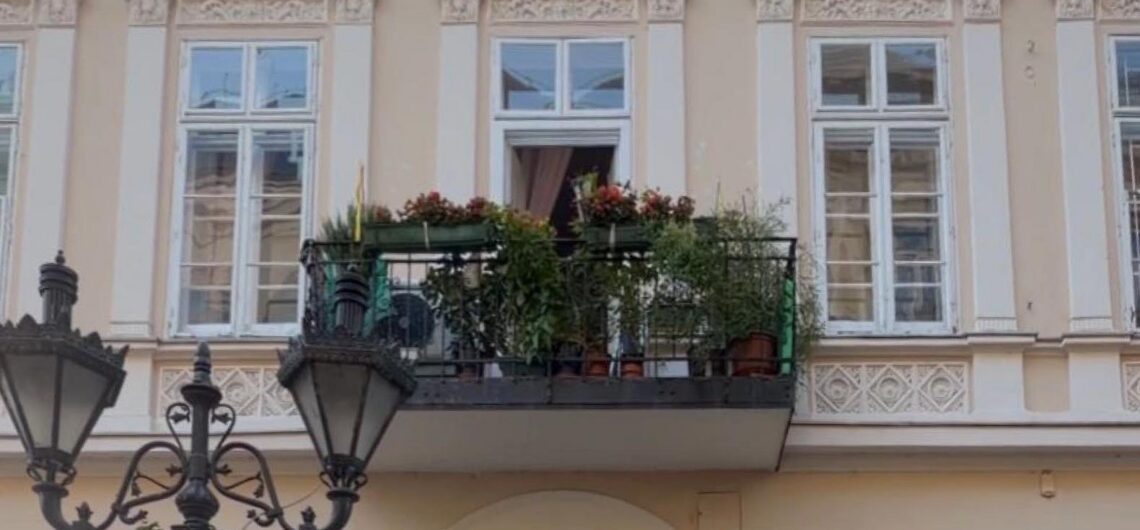
Once you start looking up in Budapest, certain details become impossible to ignore. Budapest balconies come in every imaginable shape and size, but one particular type always catches my eye: a large façade with rows and rows of windows — and just one balcony.
Sometimes it is delicate wrought iron. Sometimes it is supported by enormous stone brackets. Some are decorated with flowers, others are surprisingly simple. But there it is, sitting proudly on the façade, often directly above the main entrance.
So why just one? As with most things in architecture, there isn’t one answer that works for every building. But that balcony can be a clue to something much more interesting: the hidden hierarchy of the house behind the façade.
Not every floor was equal
Many of the grand apartment houses we see in Budapest today were built during the city’s extraordinary growth in the 19th century. And although their façades can look wonderfully harmonious, not every floor originally had the same status.
One of the most prestigious was traditionally the piano nobile, or principal floor — an architectural idea inherited from European palaces and grand residences. On Budapest apartment houses, this was often one of the lower residential floors, and its importance could be expressed on the façade through larger windows, richer decoration and, sometimes, a prominent balcony.
There was a practical reason for this hierarchy too. Before lifts became commonplace, the lower floors offered a rather attractive compromise: above some of the noise, dust and activity of the street, but without several flights of stairs between you and your front door.
So the hierarchy inside the building could become visible on the outside.
The balcony may be telling you where to look
This is where it gets interesting — because Budapest and its balconies don’t make things quite that simple. A single balcony doesn’t automatically mean “the most important person in the building lived here.”
Sometimes a balcony helps emphasise the principal floor, sometimes it marks the centre of the façade, sometimes it sits directly above the grand entrance, strengthening the symmetry of the building. And sometimes several of those ideas come together.
So I wouldn’t use balconies as a secret code for working out exactly who lived where. But I would use them as an invitation to look more closely. Look at the windows around the balcony. Are they larger or more decorated than those above? Look at the entrance below. Does everything line up? Does one part of the building seem to be asking for your attention?
The building is quietly telling you where to look.
One Idea, Dozens of Budapest Balconies
Once I started deliberately looking for these balconies, I realised just how different they are. Some have delicate wrought-iron railings. Others project dramatically over the pavement on enormous carved stone brackets. Some are restrained and elegant; others seem determined to use every decorative idea available before lunchtime.
And then, of course, there are the flowers. They belong to different periods and architectural styles, but together they reveal something I love about Budapest: even buildings that initially appear symmetrical and orderly are full of small details waiting to be noticed. This is also why I enjoy Budapest’s beautiful entrances so much. A doorway, balcony, window or piece of stonework may look purely decorative at first, but often it helps us understand how the whole façade was designed.
This is why I love exploring Budapest on foot
Last week I wrote about exploring Budapest on foot, and this is exactly the sort of thing I meant. Of course, on my Budapest private walking tours we see the famous sights. Parliament, the Castle District, St Stephen’s Basilica and the grand avenues are part of what makes Budapest extraordinary.
But walking gives us something else as well. It gives us time to notice the building between two landmarks. The doorway that happens to be open. Old lettering above a shop. A beautiful piece of stained glass. A strange face looking down from a façade. Or one balcony sitting proudly among dozens of windows.
Sometimes we stop because there is a story I want to tell. Sometimes one of my guests notices something and asks me about it. And sometimes I still stop because I’ve noticed something. After all these years, Budapest hasn’t run out of things to make me look up.
Now you’ll see them everywhere
So here’s a little challenge for your next walk through Budapest. Every now and then, stop and look at the whole façade in front of you. Is there only one balcony? Where is it? Is it above the entrance? Does it mark the centre of the building? Are the windows around it larger or more decorated? Does that floor somehow look more important than the ones above?
There may not be one simple answer. That’s part of the fun. Because Budapest becomes much more interesting when its buildings stop being a backdrop and start becoming something you can read.
And I’m afraid that now I’ve pointed out the balconies, you may start seeing them everywhere too.
If you’d like to discover Budapest and Budapest balconies this way — seeing the famous landmarks, but also the architecture, stories and little details in between — take a look at my Budapest Private Walking Tours. Every tour is completely private and can be adapted around your interests, pace and curiosity.
Sometimes the most interesting Budapest stories are hiding in plain sight.