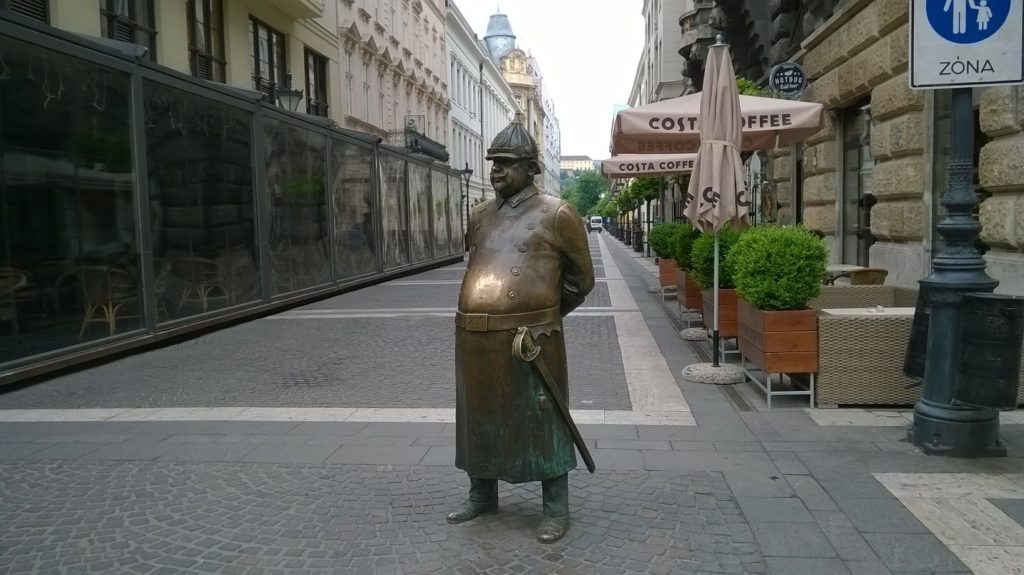
Nestled just a stone’s throw from St. Stephen’s Basilica on Zrínyi Street, the whimsical Fat Policeman statue—affectionately known as Uncle Karl—stands guard over the cobblestones of the bustling city centre of Budapest. Cast in bronze by sculptor Illyés András and unveiled in 2008, he’s dressed in a nostalgic early‑20th‑century uniform complete with a jaunty helmet and a twirly moustache. His rotund, friendly figure instantly catches the eye, and true to local superstition, his belly has become gloriously polished from the countless tourists who rub it for good luck and loosing weight—and perhaps the gift of guilt-free indulgence in Hungarian cuisine.
This monument is part of my ongoing Statues of Budapest series, which explores how meaning in this city is often hidden in plain sight.
Those seeking romance often reach up to stroke his moustache, a gesture believed to bring good fortune in love. Over the years, his well-worn features have become a testament to thousands of hopeful wishes.
Though officially titled the “Guardian of Order,” the statue’s more playful nickname speaks to its charm and the warm-hearted humor woven into Budapest’s cultural tapestry. Anecdotal measurements suggest he stands about 1.7 m tall—just over five and a half feet—making him approachable and almost lifelike in scale. He’s become a selfie magnet and a lighthearted must-see for visitors wanting to balance architectural grandeur with a bit of street‑art whimsy
By blending nostalgia, folklore, and everyday joy, the Fat Policeman encapsulates the spirit of Budapest: historical depth with a side of light-heartedness. Whether you’re capturing him in a snapshot, giving his belly a good rub, or simply pausing to admire his cheery posture, Uncle Karl offers a delightful pause in the rhythm of urban exploration—and perhaps a sprinkle of good fortune to boot.
Explore more: The 0 km Stone is featured in my Statues of Budapest collection, where famous monuments and easily overlooked details reveal the deeper structure of the city.