If you walk along the Danube in Pest, the area around the Hungarian Parliament is filled with symbols of Hungarian identity — and one of the most striking is the equestrian statue of Count Gyula Andrássy. This sculpture is part of my ongoing Statues of Budapest series, where I introduce both famous monuments and smaller details that add meaning to the city’s streetscape.

Where is the Count Gyula Andrássy statue?

The statue stands at the Hungarian Parliament building, in one of the most important public spaces in Budapest. Even if you’re only passing by for photos of the Parliament, it’s worth stopping for a minute: monuments here are carefully chosen, and Andrássy’s presence tells a very specific story about Hungary’s 19th-century political turning point.

Who was Count Gyula Andrássy?

Count Gyula Andrássy (1823–1890) was one of Hungary’s most influential politicians and statesmen. He played a key role in the events that led to the Austro–Hungarian Compromise of 1867, a major political agreement that created the Austro–Hungarian Monarchy. For visitors, this is where a statue becomes more than decoration: it highlights a moment when Hungary’s modern political structure took shape — and why this part of Budapest is so dense with national symbolism.

Why an equestrian statue?

Equestrian statues traditionally represent leadership, authority, and statehood. In Budapest, this visual language matters: statues around the Parliament are designed to communicate political continuity and historical legitimacy. Whether you love history or you simply enjoy reading the city through its monuments, Andrássy’s statue is a good example of how Budapest “speaks” in stone and bronze.

A quick tip for your visit

When you’re photographing the Parliament, try including the statue in the foreground for a stronger composition — it adds context and scale, and immediately signals that you’re not just capturing a building, but a piece of Hungarian history.

Explore more: If you enjoy noticing details like this, you might like my collection of Statues of Budapest, featuring famous monuments and hidden gems across Buda and Pest.

Equestrian statue of Count Gyula Andrássy at the Hungarian Parliament in Budapest

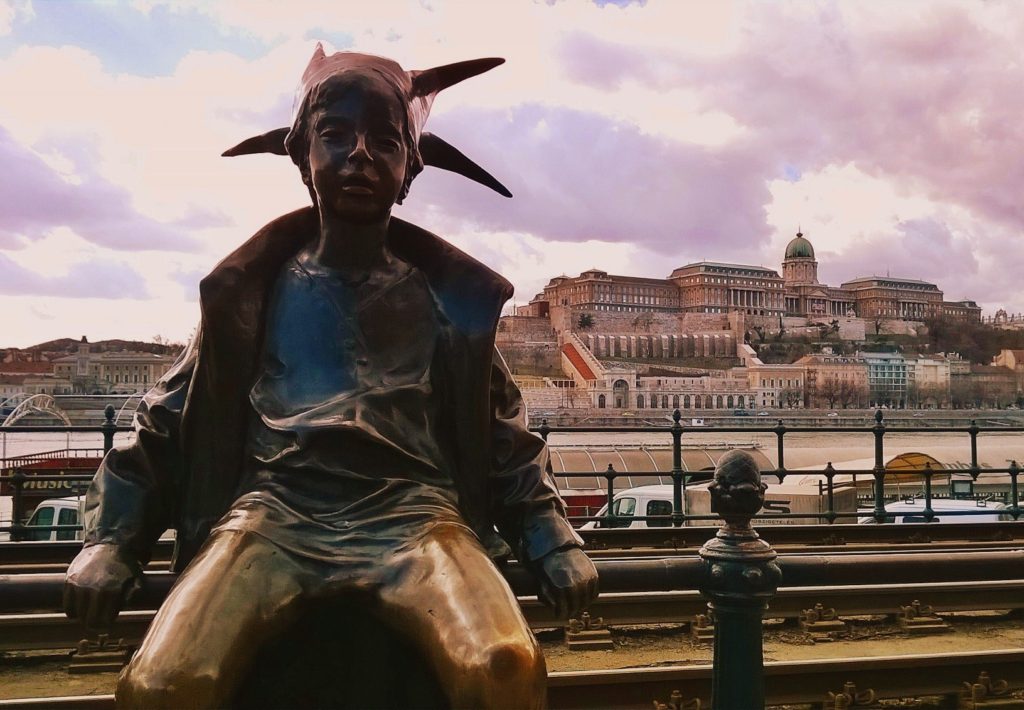
Another statue with a quiet kind of magic, the Little Princess is one of Budapest’s most beloved and photographed sculptures. Perched gracefully on the railings of the Danube Promenade, she watches the river flow past with a dreamy, childlike calm.

Created in 1989 by Hungarian sculptor László Marton, the bronze figure depicts a young girl wearing a playful paper crown and a simple robe. The statue was inspired by the artist’s own daughter, captured in a moment of childhood imagination as she played dress-up at home.

With her knees bent and her expression lost somewhere between curiosity and wonder, the Little Princess feels both intimate and universal — a small figure with an outsized emotional presence.

A small statue with a powerful setting

Despite her modest size, the Little Princess sits in one of Budapest’s most iconic locations. Behind her rise the Danube, Buda Castle, and the city’s elegant skyline, creating a contrast that makes her feel even more special.

People passing along the promenade often stop instinctively — to take a photo, to sit beside her, or simply to pause for a moment. She has a way of slowing the city down.

A local tradition: make a wish

According to local tradition, rubbing the Little Princess’s knees brings good luck. Those who believe in her magic say the key is to make a wish with a truly childlike heart.

Whether you believe in wishes or not, the ritual itself is part of the statue’s charm — a small act of hope in the middle of a busy city.

Why the Little Princess matters

The Little Princess is more than a photo opportunity. She’s a gentle reminder of imagination, innocence, and the importance of holding on to wonder, even as we grow older.

Among Budapest’s grand monuments and historic statues, she offers something rare: a quiet, heartfelt moment for anyone who chooses to notice her.

You’ll find the Little Princess near the Danube, close to the Marriott Hotel, sitting patiently on the railing — ready to listen.

Explore more: The Little Princess is part of my ongoing Statues of Budapest series, featuring both famous monuments and easily missed gems across the city.

The Little Princess statue sitting on the railing of the Danube Promenade in Budapest