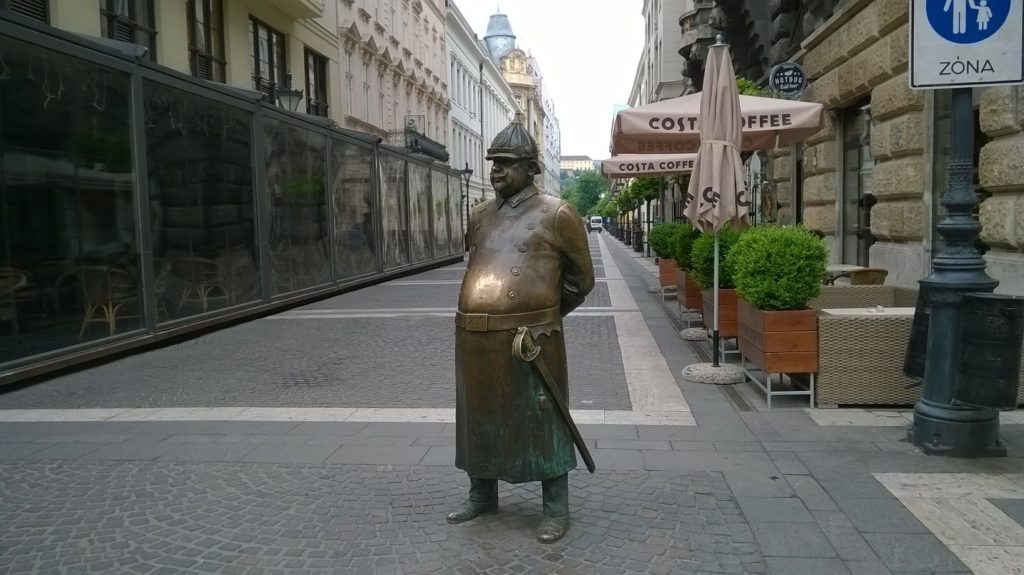
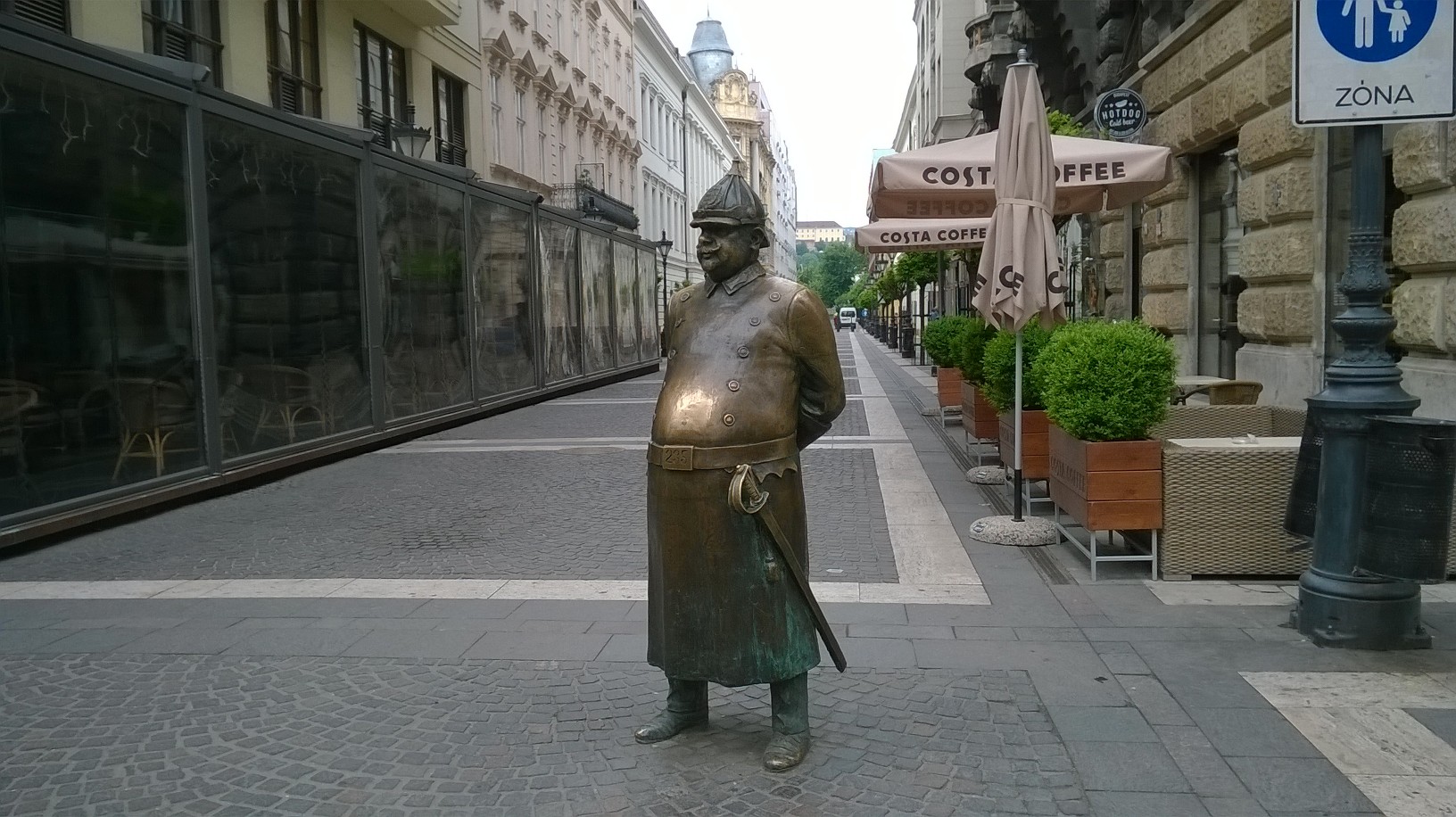
Nestled just a stone’s throw from St. Stephen’s Basilica on Zrínyi Street, the whimsical Fat Policeman statue—affectionately known as Uncle Karl—stands guard over the cobblestones of the bustling city centre of Budapest. Cast in bronze by sculptor Illyés András and unveiled in 2008, he’s dressed in a nostalgic early‑20th‑century uniform complete with a jaunty helmet and a twirly moustache. His rotund, friendly figure instantly catches the eye, and true to local superstition, his belly has become gloriously polished from the countless tourists who rub it for good luck and loosing weight—and perhaps the gift of guilt-free indulgence in Hungarian cuisine.

This monument is part of my ongoing Statues of Budapest series, which explores how meaning in this city is often hidden in plain sight.

Those seeking romance often reach up to stroke his moustache, a gesture believed to bring good fortune in love. Over the years, his well-worn features have become a testament to thousands of hopeful wishes.

Though officially titled the “Guardian of Order,” the statue’s more playful nickname speaks to its charm and the warm-hearted humor woven into Budapest’s cultural tapestry. Anecdotal measurements suggest he stands about 1.7 m tall—just over five and a half feet—making him approachable and almost lifelike in scale. He’s become a selfie magnet and a lighthearted must-see for visitors wanting to balance architectural grandeur with a bit of street‑art whimsy

By blending nostalgia, folklore, and everyday joy, the Fat Policeman encapsulates the spirit of Budapest: historical depth with a side of light-heartedness. Whether you’re capturing him in a snapshot, giving his belly a good rub, or simply pausing to admire his cheery posture, Uncle Karl offers a delightful pause in the rhythm of urban exploration—and perhaps a sprinkle of good fortune to boot.

Explore more: The 0 km Stone is featured in my Statues of Budapest collection, where famous monuments and easily overlooked details reveal the deeper structure of the city.

The Fat Policeman statue in Budapest, a playful bronze street sculpture


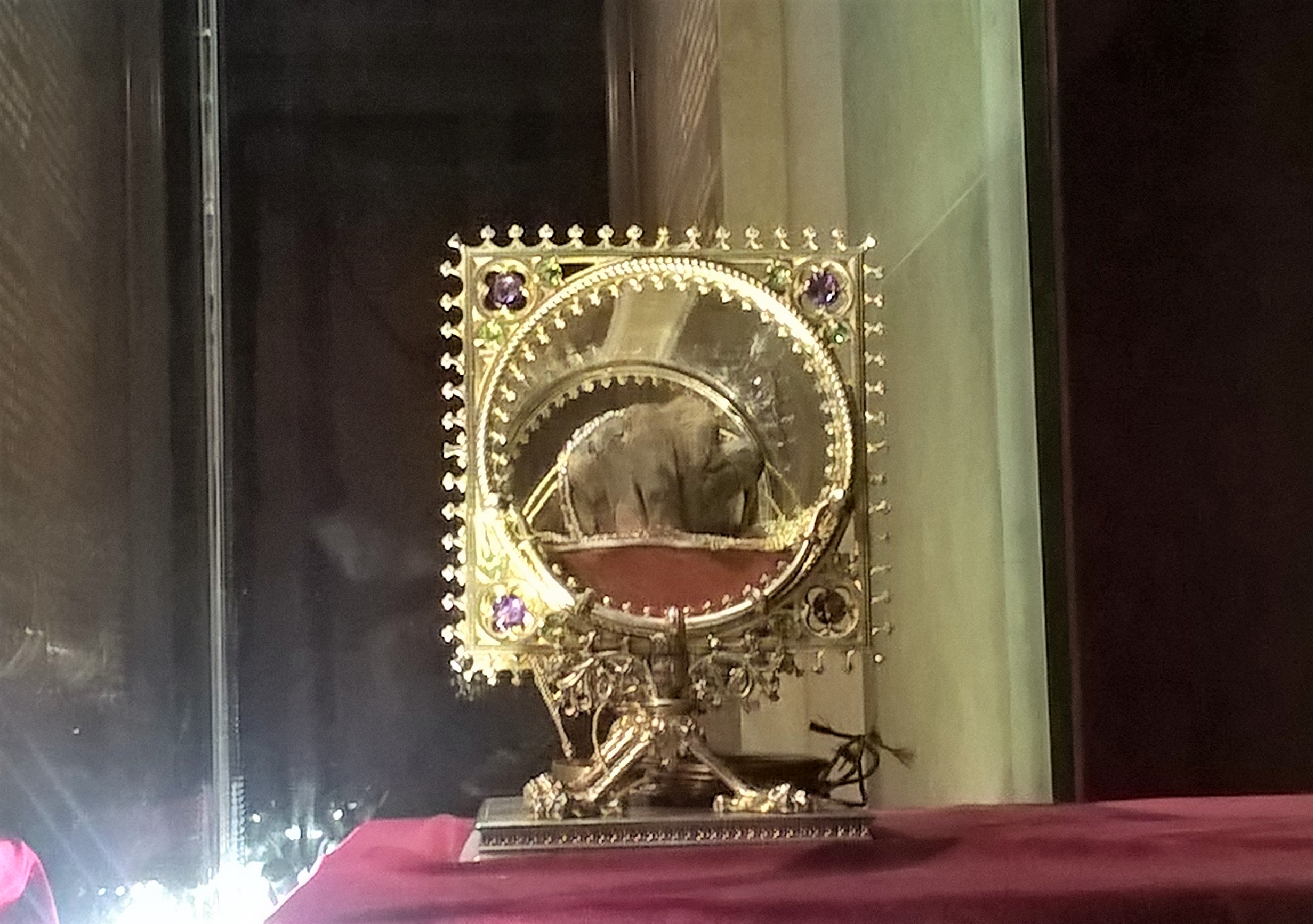
St Stephen’s mummified hand hides one of the most unusual and powerful Budapest stories, preserved for over a thousand years inside St Stephen’s Basilica.

Hidden inside St. Stephen’s Basilica, behind gilded doors and soft candlelight, you’ll find one of Hungary’s most extraordinary and deeply symbolic treasures: the mummified right hand of St. Stephen, Hungary’s first Christian king.

Who was St. Stephen?

St. Stephen (István király) was crowned in the year 1000 and became the founder of the Hungarian state and its Christian identity. His reign marked a turning point: Hungary officially joined Christian Europe, laying the foundations of the country we know today.

After his death, Stephen was revered as a saint — but the story of his right hand is anything but ordinary.

How did the mummified hand survive in Budapest?

Legend has it that when St. Stephen’s body was exhumed prior to his canonisation, his right hand and forearm were found miraculously preserved, while the rest of his body had decayed. This was interpreted as a divine sign.

The relic became known as the “Holy Right” (Szent Jobb) and, over the centuries, it travelled far beyond Hungary’s borders — hidden, stolen, rediscovered, and finally returned home.

Today, it rests in a dedicated chapel inside the Basilica, displayed in a richly decorated reliquary and illuminated like a jewel.

Seeing the Holy Right Hand of St Stephen today

Visitors to St. Stephen’s Basilica can still see the mummified hand up close. It’s not just a religious relic — it’s a powerful symbol of Hungarian history, identity, and continuity.

Even for non-religious visitors, the experience is striking. The silence, the atmosphere, and the sheer unexpectedness of seeing a thousand-year-old hand preserved in such detail often leave a lasting impression.

Visiting with a guide makes all the difference

The Basilica is included in many of my Budapest walking and driving tours, and the interior visit — including the Holy Right — is also possible. When you see the relic with a guide, the story behind it comes alive: the legends, the politics, and the very human history behind the saint.

Want to see it in person?

If you’d like to include St. Stephen’s Basilica and the Holy Right in your Budapest experience — whether on foot or by car — feel free to get in touch. I’m always happy to tailor a tour that matches your interests and pace.


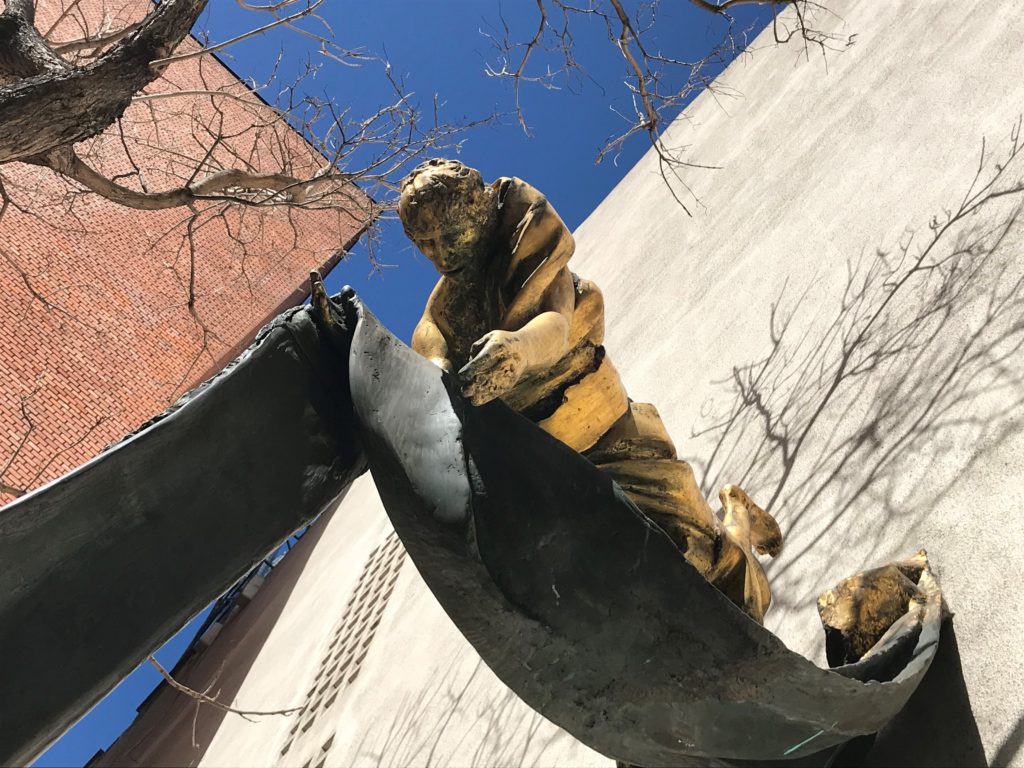
Tucked away on a quiet stretch of Dob utca in Budapest, near the lively Gozsdu Courtyard, stands a moving and quietly powerful monument: the Carl Lutz Memorial. It commemorates one of the most extraordinary humanitarian efforts in Budapest during the Second World War.

This statue is part of my ongoing Statues of Budapest series, which explores how public monuments reflect the city’s most difficult — and most meaningful — chapters.

Who was Carl Lutz?

Carl Lutz served as Vice-Consul of the Swiss Embassy in Budapest during the German occupation. Between 1942 and 1945, he used his diplomatic position, ingenuity, and moral courage to save tens of thousands of Hungarian Jewsfrom deportation and death.

By issuing protective documents, establishing safe houses, and repeatedly defying Nazi and Arrow Cross authorities, Lutz became one of the most effective rescuers in Holocaust history.

The meaning of the memorial

The Carl Lutz Memorial does not overwhelm with size or drama. Instead, it invites reflection. Placed in the heart of what was once the Jewish ghetto, its location is as important as the statue itself.

Here, remembrance is woven directly into everyday life — a reminder that courage and humanity existed even in the darkest moments of the city’s past.

Why this statue matters today

In a neighborhood now known for cafés, bars, and cultural life, the Carl Lutz Memorial anchors the Jewish Quarter in its historical reality. It asks visitors to pause, remember, and understand that the stories of survival here are real, personal, and recent.

This memorial often becomes one of the most meaningful stops on my Jewish Quarter walk, where we explore not only architecture and everyday life, but also the human stories behind the streets.

Explore more: The Carl Lutz Memorial is part of my Statues of Budapest collection, featuring monuments that reveal the city’s layered and often complex history.

Statue commemorating Carl Lutz, Swiss diplomat and Holocaust rescuer, in Budapest


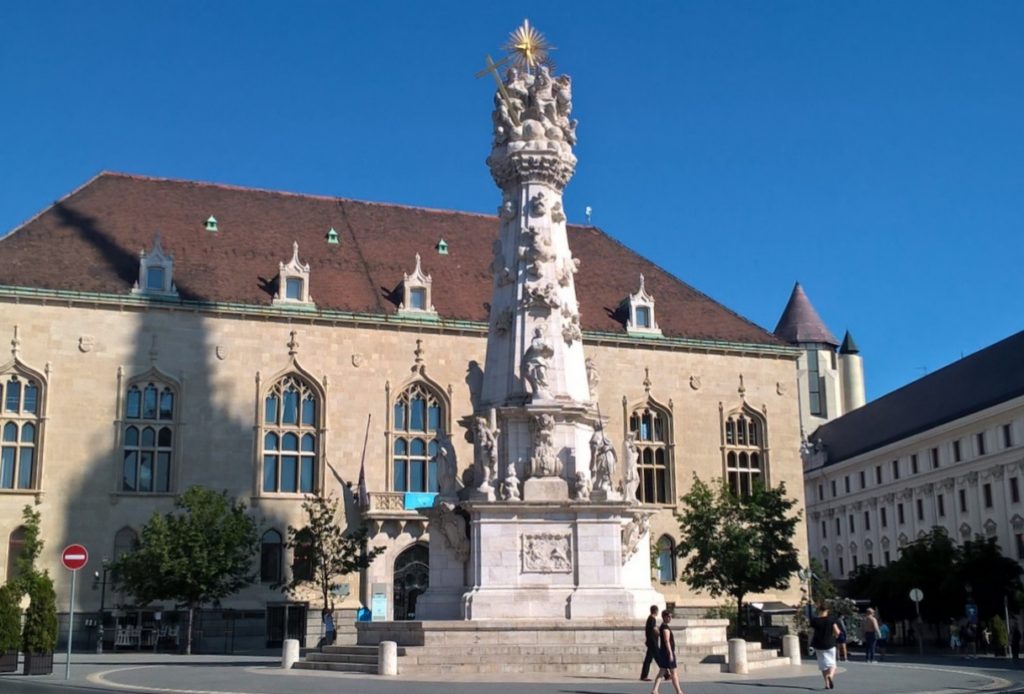
Standing quietly in the heart of the Buda Castle District, near Matthias Church, the Holy Trinity Monument is one of Budapest’s most meaningful historical memorials. Rich in symbolism and emotion, it tells a story of survival, faith, and gratitude.

This monument is part of my ongoing Statues of Budapest series, which explores how public sculptures reflect the city’s deepest historical experiences.

A monument born from survival

The Holy Trinity Monument was erected in the early 18th century by survivors of the Black Plague, one of the most devastating epidemics in European history. After enduring unimaginable loss, those who lived wanted to give thanks — and to commemorate both survival and remembrance in a lasting form.

Plague columns like this one can be found across Central Europe, but the Budapest monument stands out for its location and artistic richness.

Symbolism carved in stone

At the center of the monument rises the Holy Trinity, surrounded by saints traditionally associated with protection against plague. Every figure and detail reflects fear, hope, and faith — emotions deeply felt by those who commissioned it.

Rather than celebrating victory or power, the monument speaks quietly of vulnerability and gratitude, reminding visitors how fragile life once was, and how deeply survival was valued.

Why the Holy Trinity Monument matters

Today, the monument blends almost seamlessly into the postcard-perfect surroundings of Buda Castle. Yet behind its beauty lies a powerful reminder of a time when faith and community were often the only sources of comfort.

It invites reflection — not only on Budapest’s past, but on resilience, memory, and the human need to give thanks after hardship.

Explore more: The Holy Trinity Monument is part of my Statues of Budapest collection, featuring monuments that reveal the city’s layered history, from playful street sculptures to deeply symbolic memorials.

Holy Trinity Column commemorating plague survivors in Budapest


Budapest is full of statues. Some dominate grand squares and riverbanks, while others quietly occupy street corners, stairways, and promenades, waiting to be noticed. Together, they form an open-air museum that reflects Hungary’s history, myths, political turning points, and sense of humor.

Over the years, I’ve started paying closer attention to these sculptures while walking through the city — not as isolated sights, but as storytellers. Some are impossible to miss, others easy to overlook, yet all of them add depth to understanding Budapest beyond its famous landmarks.

This ongoing collection brings together some of the most interesting statues of Budapest: well-known monuments, playful surprises, and symbolic figures that reveal layers of the city many visitors never see.

Playful & Hidden City Statues

Not all statues in Budapest are solemn or monumental. Some of the city’s most beloved sculptures are informal, approachable, and often discovered by accident. These figures invite interaction, photographs, and sometimes a smile — offering a lighter side of Budapest’s urban landscape.

The Fat Policeman

A humorous bronze figure standing near St. Stephen’s Basilica, the Fat Policeman has become one of Budapest’s most photographed statues. Its relaxed posture and exaggerated form make it instantly recognizable, and it perfectly captures the city’s ability to mix history with irony.

Little Princess

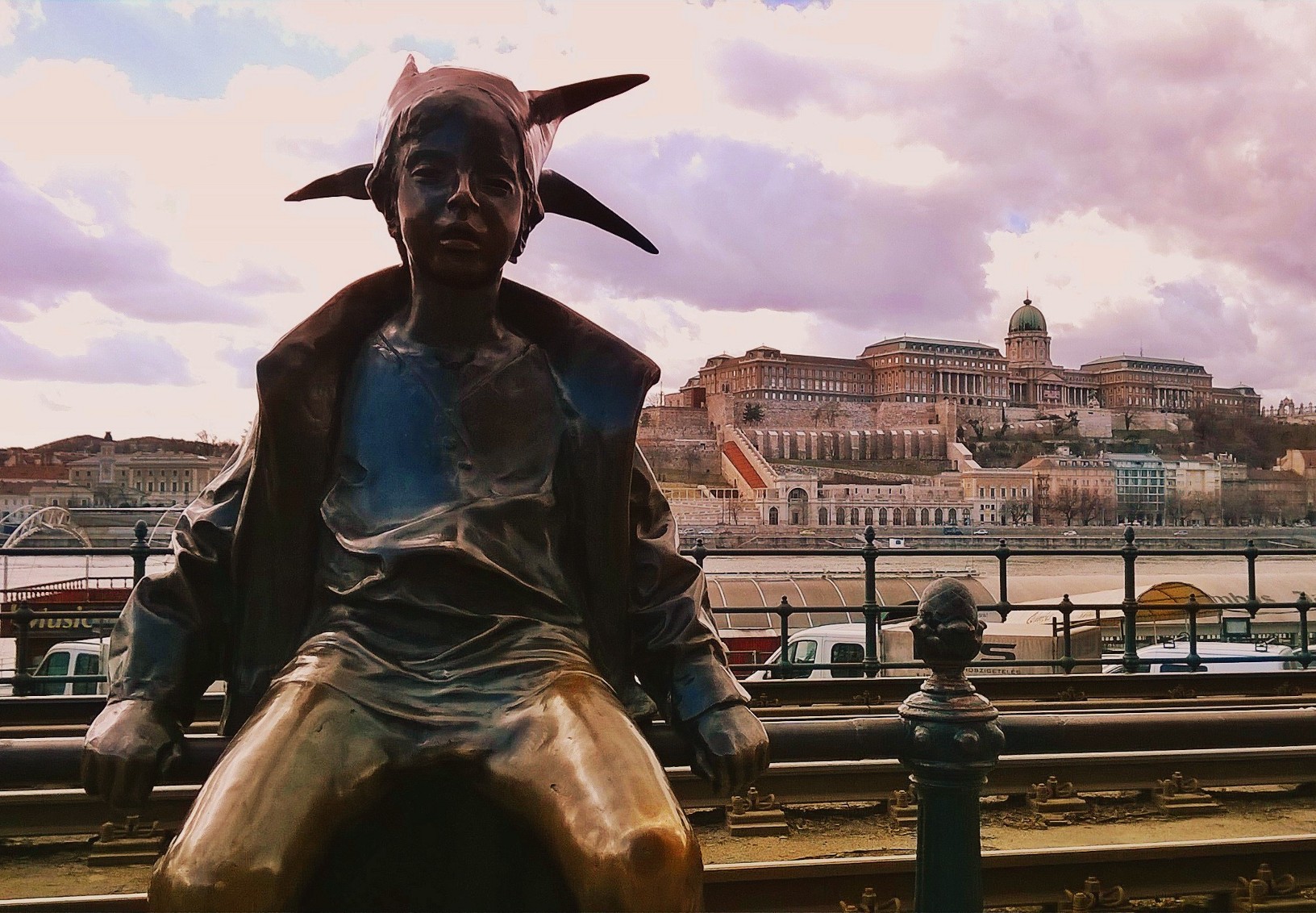
Small in size but big in popularity, the Little Princess sits along the Danube promenade. Inspired by childhood imagination, this statue has become a favorite stop for walkers along the river.

Prince Buda and Princess Pest

This symbolic pair represents the two sides of the city before their unification. Often overlooked, the statue offers a charming reminder of how Budapest came to be.

Historical & Political Monuments

Many statues in Budapest carry much heavier stories. These monuments reflect key historical figures, political eras, and collective memories — sometimes celebratory, sometimes painful.

King Matthias

One of Hungary’s most revered rulers, King Matthias appears in several statues across Budapest. His legacy is closely tied to the country’s golden age and remains deeply embedded in national identity.

Count Gyula Andrássy

A central figure in 19th-century Hungarian politics, Andrássy’s statue reflects the era of reform, modernization, and the Austro-Hungarian Compromise.

Holy Trinity Monument

Found in Buda Castle, this richly decorated column commemorates survival and renewal after devastating plague epidemics. It is both a religious symbol and a historical document carved in stone.

Carl Lutz Memorial

This understated but powerful memorial honors the Swiss diplomat who saved thousands of Hungarian Jews during World War II. It stands as a reminder of moral courage during one of Budapest’s darkest periods.

Stalin’s Boots

All that remains of a once-colossal statue, Stalin’s Boots are among the most symbolic remnants of Hungary’s communist past. Their absence speaks louder than the monument ever did.

Mythical & Symbolic Figures

Some statues draw from legend, mythology, and abstract symbolism rather than specific historical events. These sculptures often blend pagan roots, national identity, and artistic interpretation.

Turul Bird

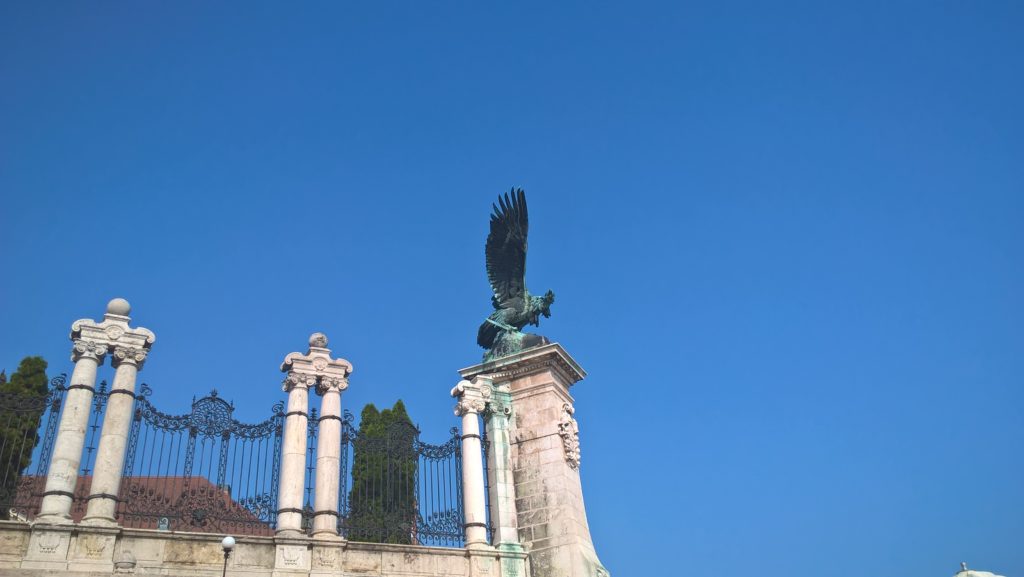
A mythical creature central to Hungarian origin legends, the Turul appears in multiple locations around the city. It represents strength, protection, and national mythology.

Sphinx

Unusual and unexpected, the Sphinx statue adds a touch of mystery to Budapest’s sculptural landscape. Its presence raises more questions than answers — part of its charm.

0 km Stone

Marking the point from which all road distances in Hungary are measured, the 0 km Stone is both symbolic and practical, quietly anchoring the country’s geography.

Lesser-Known Curiosities

Some statues remain largely unnoticed even by frequent visitors, yet they add richness to the city’s visual and cultural fabric.

Julianus and Gerhardus

This sculpture commemorates medieval monks whose journeys connected Hungary to distant lands. It is a reminder of the country’s early links to the wider European world.

Seeing Budapest Through Its Statues

Taken together, these statues reveal Budapest as a city shaped not only by kings and empires, but also by humor, memory, and symbolism. They reward those who slow down, look closer, and ask questions.

I often point out these sculptures while walking through the city, not as checklist sights, but as conversation starters — details that help make sense of Budapest’s layered past and vibrant present.

This page will continue to grow as more statues and stories are added, forming an evolving portrait of Budapest told through bronze, stone, and imagination.